



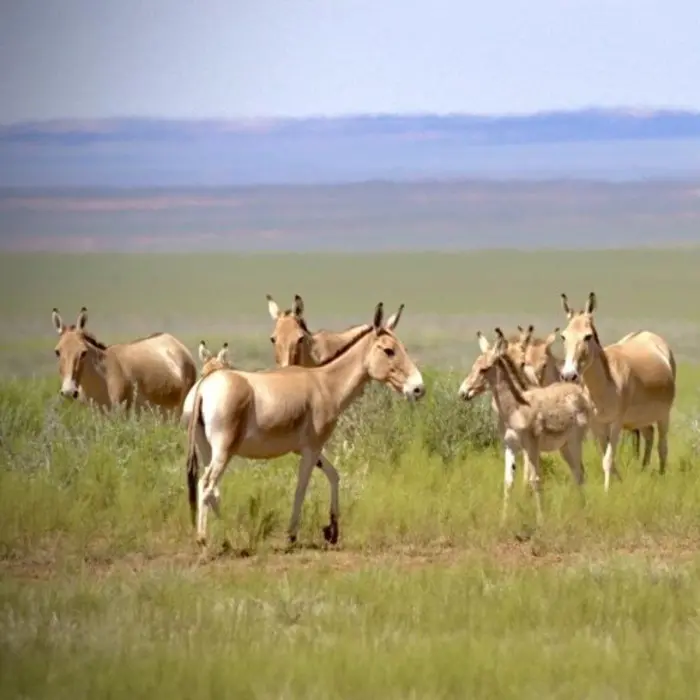
The Asiatic wild ass, known locally as khulan (Equus hemionus), has returned to eastern Mongolia and is showing clear signs of re-establishing a population after more than 65 years of absence from the region.
Findings published this month in the journal Oryx show that khulan are now regularly present in multiple groups east of the Trans-Mongolian Railway. For decades, fencing along the railway has restricted movement of khulan and other migratory species. Recent efforts to create safe crossing points are now allowing animals to move more freely across this barrier.
Maintaining connectivity across this landscape is critical for khulan, allowing them to move between seasonal grazing areas and water sources in a highly variable and arid environment, and supporting the broader functioning and resilience of Mongolia's steppe ecosystem.
Collaborative efforts between the Wildlife Conservation Society and Mongolian government partners have addressed this challenge through several targeted interventions, including testing of temporary unfenced sections along the railway and the formal designation in May last year of a monitored "safe passage" zone near the China-Mongolia border kept free of fencing.
Together, these measures appear to be helping khulan cross the railway, including during winter. Monitoring shows that crossings occurred in recent years and follow-up surveys have since recorded hundreds of khulan on the eastern side. This suggests that khulan are not only passing through, but beginning to re-establish in the region.
The Mongolian Gobi supports the world's largest khulan population -- approximately 91,000 animals, more than 84% of the global total. The species nevertheless faces ongoing threats from habitat fragmentation, competition with livestock, illegal hunting and climate change. As one of the most wide-ranging terrestrial mammals, khulan require extensive, connected habitats to persist in Mongolia's variable climate.
Plans are advancing for a new local protected area east of the railway to support long-term habitat security and khulan recolonisation, according to the Wildlife Conservation Society.