



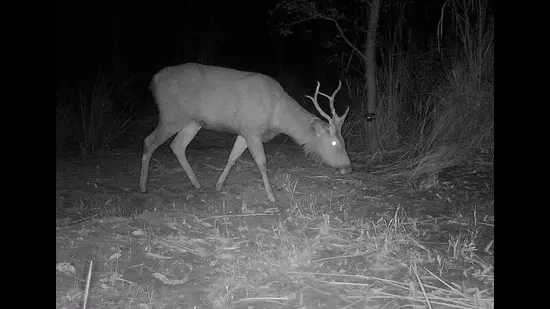
Sambars afford a ringside view of their behaviour for those who walk the Sukhna Lake Nature Trail that bisects the jungles on the northern banks. Deer life here is secure and sambars resultantly display tame, confiding behaviour by grazing alongside the trail like cattle. Whereas, in the dense jungles and Shivalik foothills lying further north in the Sukhna Wildlife Sanctuary (SWS), the deer are wary and adapt to harsher, undulating terrain characterised by sharp, eroding cliffs.
A basic adaptation of sambars to SWS terrain during cold weather was noted by scientists of the Wildlife Institute of India (WII), Dehradun, while conducting the Rapid Assessment of Biodiversity of UT Chandigarh in November 2025. In its last report of 2021 titled, ‘Status of Wildlife in Sukhna Wildlife Sanctuary’, the WII had assessed the sambar as the ungulate enjoying the highest density (number of individuals/km2) of 18.08±4.22 and population between 290–763 individuals. Assessments from the November 2025 survey have yet to be finalised by WII.
WII scientists noted in November 2025 that Sambars were climbing atop the heights and basking in a larger envelope of sunrays. The vantage points also gave them better security and escape routes from humans, leopards and free-ranging dog packs from peripheral villages. When night came, the sambars would come down to the rivulet beds and flat scrublands for foraging and water. The nocturnal descent saved deer from freezing temperatures on ridgeline tops exposed to windchill and related winter conditions.
The scientists’ field observations are backed by Nikhil Sanger, a former Punjab State Wildlife Advisory Board member and one who has trekked the Shivalik’s remotest rivulets and trickiest ridges. “Sambars relish small winter ‘ber’ (berries) that grow mostly on top. I had placed a camera trap on a hillocks trail of Banah falling in the Kathgarh forest block (Nawanshahr). Images revealed sambars routinely descending in a long line from the Banah tops in the early night,” Sanger told this writer.
Chores in the Sukhna ponds
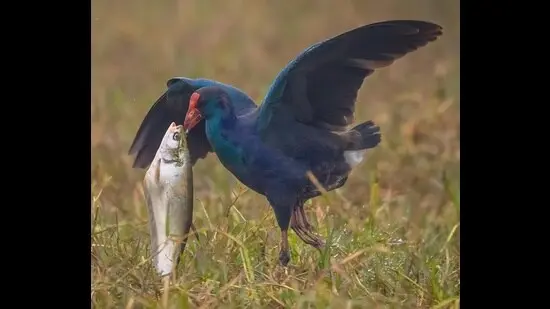
The Grey-headed swamphen is a bird seen up and close in the silted ponds of the Sukhna Lake’s regulator-end. She is coloured in arresting tones of purple, blue and red, and charms the observer’s imagination with her diligent work among the marshes.
The swamphen’s behaviour is punctuated with an “explosive, nasal, rising quinquinkrrkrr” call as she pokes about in the marshes for food while keeping a sharp eye on rivals and threats. Croaks and nasal grunts contribute to her varied phonetics. A characteristic behaviour is to frequently flick the tail up, revealing fluffy white “underpants”!
Though described as clumsy by some bird experts, the swamphen actually displays the skills of tightrope walking by clinging and balancing on flimsy reed stems, which are all too willing to bend quickly and topple a pretentious Humpty Dumpty. The swamphen’s ceaseless movements, a bossy, self-assured look for neighbours and earnest attention to her tasks invite imaginative comparison to a homemaker’s backyard routines.
Recently, a pair of swamphens encountered about two dozen checkered keelback snakes basking in three entwined groups. One swamphen went close to the keelbacks and let out a series of calls to pinpoint the heavy serpentine presence. Though she seemed to literally snort at them with contempt, a niggling fear could be detected in her undertones.
The swamphen then clambered aboard the reeds and having got above the basking snakes, she let out a series of calls that a wee bit stirred the basking snakes. That alerted a little egret stalking the waters nearby for fish / frogs. The snowy white bird abandoned her hunt and made for the keelbacks to examine them from a few inches away by extending her long, spear-like bill. But the keelbacks kept a sagely calm.
Remarkably, beyond this, there was no physical aggression between birds and snakes. They were simply not each other’s food items as adults though they could constitute a mutual threat to eggs and young ones in breeding seasons.