



Chennai Super Kings spent ₹14.20 crore each on Kartik Sharma and Prashant Veer at the IPL 2026 auction. Both are uncapped teenagers, bought to add aggression and youth to a middle order that was crying out for it. Together, they cost the franchise ₹28.40 crore. So far, they have delivered nothing.
In the match against the Punjab Kings at Chepauk, Kartik Sharma
came in at No. 6 at a crucial stage of the innings. He was dismissed for just 1 run by Marco Jansen.
Prashant Veer, making his IPL debut, batted at No. 7 and remained unbeaten. But, he scored just 6 runs from 7 balls. He had almost no opportunity to leave a real mark on the game.
Two matches in, the combined return of CSK's two big-money young buys is almost zero. The auction-table optimism has now met IPL reality.
Enter Sarfaraz Khan. CSK signed him for ₹75 lakh. It’s effectively pocket change compared to what they spent on Kartik and Veer.
Remember, Sarfaraz Khan is a way bigger star in Indian cricket than the other two youngsters. After years of consistent domestic performances, Khan received his Test cap from Anil Kumble in February 2024.
On debut, Sarfaraz impressed with a 48-ball fifty, equalling Hardik Pandya for the joint-second fastest half-century by an Indian on Test debut. He followed it with scores of 62 and 68*. He became only the fourth Indian to score twin fifties in his first Test.
Later in October that year, against New Zealand in Bengaluru, Sarfaraz scored his maiden Test century. His 150 off 195 balls came after India struggled early. It helped the team recover and stay competitive in the match.
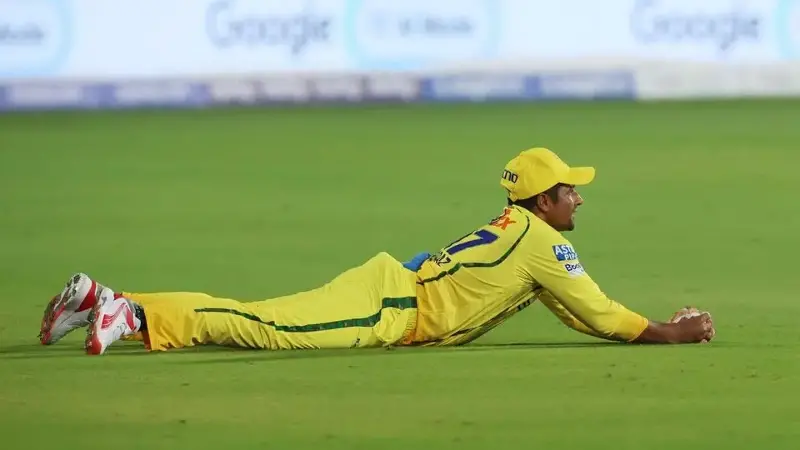
On 3 April, when Sarfaraz Khan batted at No. 4 against PBKS, he did something the squad's expensive teenagers could not: he took the game on.
His 32 off 12 balls included a hat-trick of boundaries against Arshdeep Singh in consecutive deliveries. He attacked when it mattered. He briefly shifted momentum and gave the innings a jolt of energy.
To put it in context, while Sarfaraz scored 32 off 12, Shivam Dube, batting alongside him, had scored 14 off 14 at the same stage. That tells you everything about the quality of what Sarfaraz Khan produced.
The pattern continued into the RCB match on 5 April. Sarfaraz hit a quickfire 50 from 25 balls to keep CSK alive after yet another top-order collapse.
This is the problem CSK now face. The two players they bought to inject freshness and finish games are struggling to find their feet. The one player doing exactly that job is a trade-off buy who costs a fraction of the price.
There is no shame in Kartik Sharma or Prashant Veer struggling early. Both are teenagers, making their first real appearances under IPL pressure. The game is hard. Debuts are brutal. That grace period is fair.
But, the irony is hard to ignore. CSK's most reliable middle-order performer right now is neither of their high-profile investments. It is the unassuming, underpriced veteran doing the job quietly at No. 4.
CSK: Pay disparity
Sarfaraz Khan was picked at his base price of ₹75 lakh during the auction. When divided across 14 league matches, his earnings come to around ₹5.36 lakh per match.
In comparison, Kartik Sharma and Prashant Veer are earning significantly higher. Both were bought for ₹14.20 crore each. That means they are earning over ₹1 crore per match each.
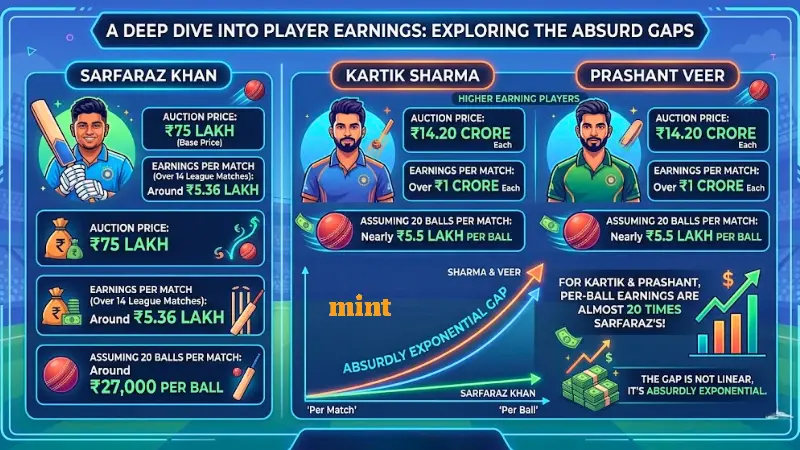
If we assume these players play 20 balls per match on average, the gap is not linear; it’s absurdly exponential.
For Sarfaraz Khan, it’s around 27,000 per ball. For Kartik Sharma and Prashant Veer, it’s nearly 5.5 lakh per ball.
A similar example could be Rinku Singh in KKR. His salary was ₹55 lakh during 2022-2024, when he famously chased 29 runs against the Gujarat Titans in 5 balls. However, Kolkata Knight Riders realised the potential of its employee and raised the salary to ₹13 crore for 2025-2026.