


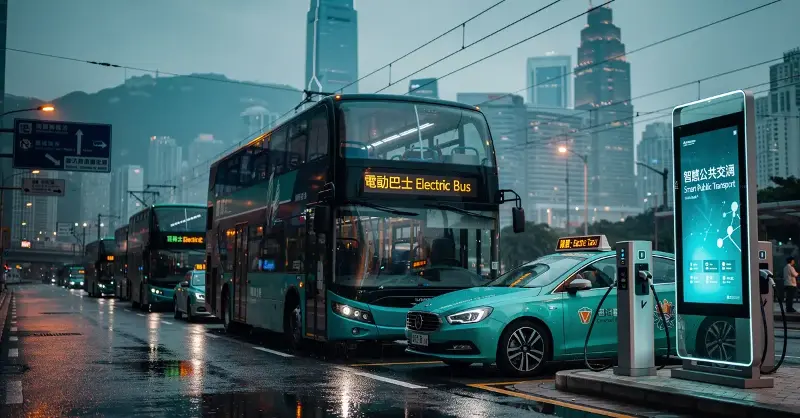
Hong Kong authorities have outlined progress in the transition to electric public transport and commercial vehicles, while confirming that existing deadlines for replacing older diesel vehicles will remain unchanged. In a written reply to the Legislative Council on 7 October 2026, the Secretary for Environment and Ecology said the government would continue promoting electric vehicles as part of its wider carbon neutrality objectives and roadside air quality strategy. Details of the response were published through the official government statement.
The update covers the adoption of electric taxis, buses and public light buses, alongside subsidy schemes and plans to phase out Euro IV diesel commercial vehicles. The measures form part of Hong Kong’s broader transport modernisation agenda, which also includes expanded charging infrastructure and digital mobility planning. Previous initiatives include efforts to support charging infrastructure for electric public transport.
Electric vehicle registrations continue to rise
Government figures show continued growth in the registration of electric public transport vehicles between 2023 and August 2026. During the first eight months of 2026, 634 electric taxis, 57 electric buses and nine electric public light buses were newly registered.
As at the end of August 2026, Hong Kong had 183,620 registered electric vehicles, representing 20 per cent of all registered vehicles in the territory. Private cars accounted for the largest share, with electric vehicles making up 27.5 per cent of registered private cars.
Among public transport categories, electric taxis represented 8.9 per cent of all taxis, while electric buses accounted for 1.5 per cent of buses and electric light buses represented 0.5 per cent of light buses.
Taxi subsidy scheme sees mixed response
The government launched its electric taxi subsidy scheme in December 2024 with the aim of supporting the purchase of 3,000 electric taxis. Each eligible vehicle receives a subsidy of HK$45,000 (approximately US$5,800).
Between the launch of the scheme and August 2026, authorities issued five rounds of invitations covering 8,448 taxis registered on or before 20 October 2016. By the end of August 2026, owners of 3,578 taxis had accepted subsidy quotas, while 1,152 electric taxis had completed licensing and qualified for subsidy payments.
However, the government said owners of 3,527 taxis either declined participation or did not respond during the first four invitation rounds. Another 1,343 taxi owners from the latest invitation round had yet to reply before the October deadline.
According to information gathered from the taxi sector, some operators were taking a cautious approach to fleet replacement because of changing economic conditions rather than concerns over vehicle model availability or programme deadlines.
The subsidy programme requires participating taxi owners to place orders for electric taxis within six months of receiving an invitation and complete vehicle licensing within 12 months of procurement documentation. Authorities said extensions could be considered in special circumstances on a case-by-case basis.
Charging infrastructure remains a priority
The government said it continues to work with charging service providers and the taxi trade to improve access to charging facilities. Existing infrastructure includes fast chargers funded through the HK$300 million (approximately US$38.6 million) Fast Charger Incentive Scheme, charging stations converted from petrol filling sites and depot facilities opened to taxis by franchised bus operators.
Authorities also referenced newer charging approaches, including battery swapping systems, mobile charging units and high-capacity rapid charging technologies. The government has separately supported new charging sites, including the award of a charging station development project in Tseung Kwan O.
Electric bus transition and diesel phase-out continue
Hong Kong’s franchised bus operators confirmed participation in a government-supported electric bus procurement scheme in August 2025. The programme aims to procure about 600 electric buses by the end of 2027, with delivery and registration scheduled for completion by the end of 2029.
The government stated there are currently no plans to extend procurement or registration deadlines for the electric bus scheme.
Authorities also confirmed they would not extend application deadlines under the Ex-gratia Payment Scheme for Phasing Out Euro IV Diesel Commercial Vehicles. As at the end of August 2026, 310 Euro IV non-franchised buses and 82 light buses remained in operation.
The scheme, launched in 2020, aims to phase out approximately 40,000 Euro IV diesel commercial vehicles by the end of 2027. Officials said more than 33,700 eligible vehicles had already been retired, representing nearly 85 per cent of the total target.
The government said maintaining the timetable is important for reducing roadside pollution and meeting Hong Kong’s target of lowering average ambient PM2.5 concentrations to below 14 micrograms per cubic metre by 2030.
This article is created with the assistance of OpenGov AI.