



A shape can be considered complex because it has many sides. A complex melody may feature varied pitches and rhythms. Does the mind treat these as separate features, or can it recognize something common beneath their differences?
For example, a 2017 study in PLOS Computational Biology suggested that people make sense of patterns by finding compact rules within them. The researchers found that people anticipated sequences of spatial locations using underlying regularities, such as symmetry and repetition.
However, new research suggests that we may be able to expand this understanding to identify an underlying shared quality in the complexity of unrelated things that we see, hear and touch. Tal Boger and Chaz Firestone of Johns Hopkins University explored that hypothesis in 11 experiments designed to reveal connections between diverse examples of complexity. The findings are published in Nature Human Behaviour.
Their findings point to a possible broad mental shortcut that may help humans navigate an information-heavy world.
A rule that travels
Boger and Firestone created a game in which participants chose one of two items to earn virtual coins. Some were rewarded for selecting the simpler option; others for selecting the more complex one. The rules of the game were not disclosed.
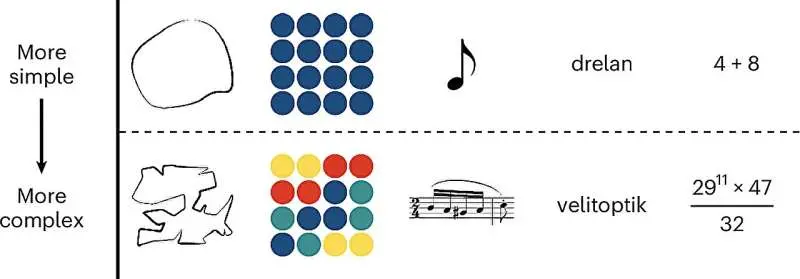
After multiple learning trials, the researchers changed the type of item. A player who had been trained using shapes might now choose between a single note and a sequence with varying pitches and tempos. With no feedback on the new category, participants had to decide whether their earlier strategies to gain the most coins still applied.
After playing both sections of the game, switching between shapes and sounds, about 72% of the 96 participants followed the learned rule, compared with the 50% expected by chance.
The connection also extended to other experiments with unfamiliar letter strings, mathematical expressions, and colored dot arrays. When the researchers tested these other categories, the rule transferred reliably in 9 of the 10 possible pairings.
Adherence to the learned rule even crossed from vision to touch. Participants felt 3D-printed outlines hidden inside boxes, then chose between visible dot patterns, or completed the task in the opposite order. In that experiment, about 82% of the 99 participants carried the rule across the test.
Additional games were designed to determine whether participants were simply choosing examples that presented more exaggerated characteristics. The team found the rule did not reliably extend to brighter, larger or more saturated objects, suggesting that complexity was the true defining relationship.
The games, therefore, encouraged people to look for connections. But when simple and complex examples were juxtaposed in incongruous ways, players became less accurate in their judgements.
The shapes people could not quite ignore
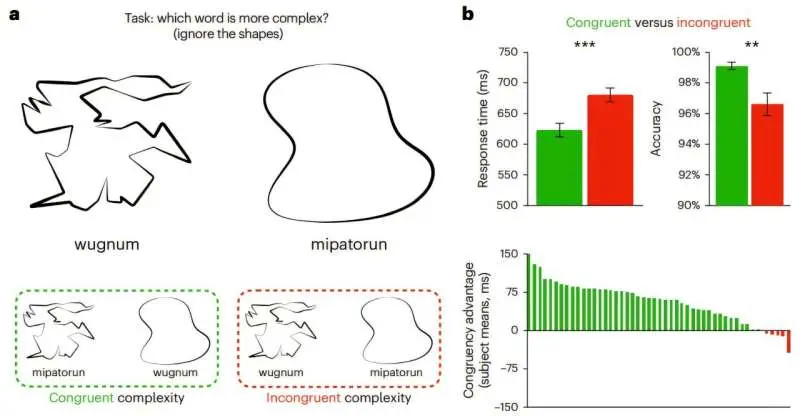
To explore this angle, the team had 48 participants judge which of two invented words was more or less complex. The simpler strings had two syllables and the more complex ones had four. Above each appeared a shape that participants were explicitly told they could ignore.
When a complex shape accompanied a simple word, and a simple shape accompanied a complex word, participants responded more slowly and made more mistakes than when the pairings matched.
The irrelevant shapes were therefore intruding on judgments about the words. This suggested that the connection could operate automatically, without people deliberately searching for a shared reward rule.
A preference that crosses senses
The final experiment moved beyond learning rules and making correct judgments and instead asked whether the same connection affected subjective choices. This time, 150 participants chose which items they found more or less beautiful, comparing pairs from one category at a time. There were no rewards offered or right answers identified.
People who were more drawn to complex shapes also tended to favor complexity in melodies, dot patterns, letter strings and mathematical expressions. The preferences did not line up perfectly, but they were more consistent across categories than chance would predict.
The findings suggest that our responses to these different experiences draw on a shared sense of complexity. The researchers state, "Together, these results suggest that the mind possesses a unified representation of complexity abstracted away from the surface features of a given stimulus, opening the door to questions concerning the evolutionary, developmental and computational foundations of complexity representation."
How that capacity develops remains an open question, but its influence appears to reach beyond making judgements and choosing preferences. It may offer a possible explanation for why an idea deemed "too complicated" can feel similar whether we are reading, listening, looking or learning.
Written for you by our author Andrew Zinin, edited by Lisa Lock, and fact-checked and reviewed by Robert Egan—this article is the result of careful human work. We rely on readers like you to keep independent science journalism alive. If this reporting matters to you, please consider a donation (especially monthly). You'll get an ad-free account as a thank-you.
Publication details
Tal Boger et al, Complexity is a unified cognitive kind, Nature Human Behaviour (2026). DOI: 10.1038/s41562-026-02502-8
Who's behind this story?

Andrew Zinin
Master's in physics with research experience. Long-time science news enthusiast. Plays key role in Science X's editorial success. Full profile →

Lisa Lock
BA art history, MA material culture. Former museum editor, paramedic, and transplant coordinator. Editing for Science X since 2021. Full profile →

Robert Egan
Bachelor's in mathematical biology, Master's in creative writing. Well-traveled with unique perspectives on science and language. Full profile →
© 2026 Science X Network
Citation: Prefer intricate shapes? You may also favor complex melodies (2026, September 23) retrieved 23 September 2026 from https://phys.org/news/2026-09-intricate-favor-complex-melodies.html
This document is subject to copyright. Apart from any fair dealing for the purpose of private study or research, no part may be reproduced without the written permission. The content is provided for information purposes only.