



Biologists group animals with similar traits into broad categories called orders. Despite their similarities, animal species in the same order can have very different average lifespans.
One of the most notable examples is the primate order, which includes numerous species ranging from humans to apes, monkeys, lemurs, lorises and tarsiers. Interestingly, past studies have shown that humans typically live longer than any other primate species.
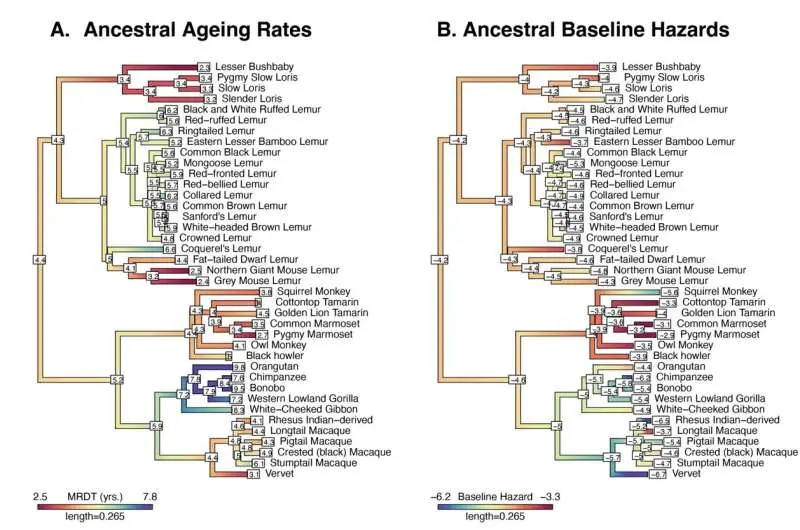
Researchers at Calico Life Sciences LLC, CleMetric and the University of Wisconsin-Madison recently carried out a study aimed at better understanding how aging changed throughout the evolution of primates. Their paper, published in Proceedings of the Royal Society B, estimates aging parameters for 39 different primate species and uses this information to reconstruct ancestral aging rates.
"It has been recognized for a long time that compared to other mammalian species, humans age at a relatively slow rate," Eugene Melamud, first author of the paper, told Phys.org.
"Going back to 1825, Benjamin Gompertz used mortality tables of England's population to estimate the rate of aging (i.e., how quickly the risk of dying increases) to be ~8% per year. The main motivation for this study was a question about how early in our evolutionary history this slow aging rate evolved. To answer this question, I needed to attain lifespan information for as many species of primates across the primate lineage."
Tracing primate aging across many species
The researchers analyzed mortality data stored in the Primate Aging Database (PAD), a large-scale resource for studying non-human primate aging, compiled with the support of the National Institute on Aging (NIA). This database contains life-history data from different animal conservation sites and zoos worldwide.
"With the help of Wendy Newton, a curator working on the PAD project, we were able to curate lifespan history for 39 species of primates, which formed the basis for all downstream analysis," explained Melamud.
To delineate aging characteristics of different species of primates, the researchers relied on a statistical approach that draws from the Gompertz model of mortality. This is a mathematical model that describes how the risk of dying increases starting in early adulthood.
"To robustly estimate aging parameters, we used multiple modeling techniques, based on phylogenetically informed life tables and Bayesian models to jointly model multiple species," said Melamud. "All models showed high correspondence, which then allowed us to use this information to infer aging parameters for ancestral tree nodes."
Understanding why related species have very different lifespans
A surprising finding emerged from this study. Despite the large variation in lifespan between primates, aging rates have remained remarkably stable across primate evolution, while their baseline mortality risk (how likely an animal is to die upon reaching adulthood) varied widely.
"For me, the biggest discovery was that the aging rate of our distant ancestors, going back to the divergence of apes from Old World monkeys, was approximately the same as we see in humans today," said Melamud.
"This implies that slow aging evolved early in the history of apes and has remained approximately unchanged for the last 20–30 million years. Pragmatically, this also means that we are unlikely to discover the genetic basis of slow aging by studying human populations alone."
The implication of this study is that to better understand the genetic basis of slow aging, researchers will need to perform cross-species comparative studies spanning many primates. Meanwhile, Melamud and his colleagues are planning further analyses of the PAD database that will focus on other dimensions of aging.
"Moving forward, our objective is to leverage the extensive data available in the PAD, including various biochemical and physiological metrics," added Melamud. "We would like to identify the strongest biochemical predictors of aging rates, in hopes of uncovering molecular mechanisms associated with slower aging."
Written for you by our author Ingrid Fadelli, edited by Sadie Harley, and fact-checked and reviewed by Robert Egan—this article is the result of careful human work. We rely on readers like you to keep independent science journalism alive. If this reporting matters to you, please consider a donation (especially monthly). You'll get an ad-free account as a thank-you.
Publication details
Eugene Melamud et al, Phylogenetic reconstruction of ancestral ageing rates in the primate lineage, Proceedings of the Royal Society B: Biological Sciences (2026). DOI: 10.1098/rspb.2025.1237.



© 2026 Science X Network
Citation: Primate evolution kept aging rates stable for 25 million years despite lifespan gaps (2026, June 27) retrieved 27 June 2026 from https://phys.org/news/2026-06-primate-evolution-aging-stable-million.html
This document is subject to copyright. Apart from any fair dealing for the purpose of private study or research, no part may be reproduced without the written permission. The content is provided for information purposes only.