



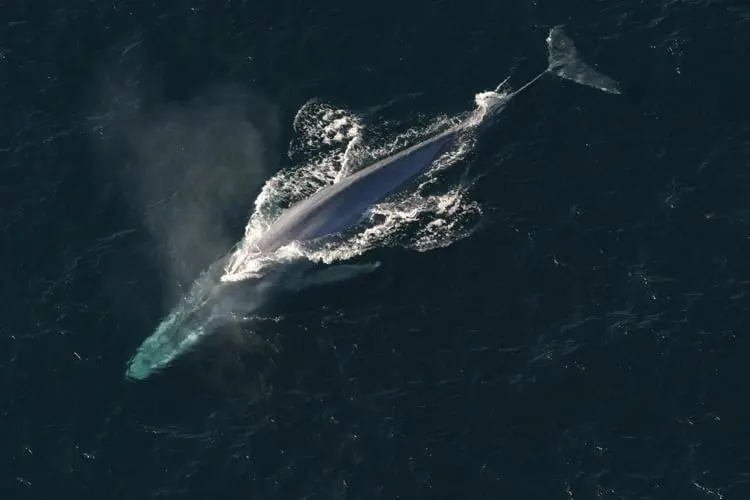
The blue whale is not just the largest animal alive today. By mass, it is almost certainly the largest animal science has ever confirmed, outweighing even the greatest dinosaurs known from the fossil record.
That comparison can feel strange because dinosaurs have become the default image of biological scale. Museum halls are built around their bones. Children learn their names as shorthand for enormous bodies. Yet the animal that pushes size furthest is not a skeleton mounted under lights. It is a warm-blooded marine mammal that still rises to breathe, still feeds on krill, still sings through deep water, and still passes close enough to the California coast that people can see it in the right season.
According to NOAA Fisheries, blue whales can reach up to 110 feet and up to 330,000 pounds. NOAA describes them as the largest animals ever to live on the planet. They are also listed as endangered under the U.S. Endangered Species Act and protected under the Marine Mammal Protection Act.
That combination is what makes the blue whale so unusual in public imagination. It belongs in the same mental category as deep time and extinct giants, but it is still part of the living ocean.
The size comparison is about mass
Blue whales are often compared with dinosaurs, but the comparison needs one important caveat: length and mass are not the same thing.
Some sauropod dinosaurs, the long-necked plant-eaters that included titanosaurs, may have rivaled or exceeded blue whales in length. Fossil animals are also difficult to measure with total certainty because scientists often work from incomplete skeletons and must estimate missing anatomy. New fossils can change rankings.
Mass is the cleaner point. A very large blue whale can weigh around 150 metric tonnes. Even the huge titanosaurs described in modern paleontology fall below that. In 2017, a team writing in Proceedings of the Royal Society B described Patagotitan mayorum as among the largest sauropods known and one of the most complete giant titanosaurs, but the animal still sits in a different weight class from the biggest blue whales.
This does not make dinosaurs less extraordinary. It makes the blue whale more surprising. The biggest body in the history of animal life is not preserved in rock. It is a breathing animal that evolved in the sea.
Why the ocean made it possible
On land, extreme size comes with punishing structural costs. Legs must carry the animal. Bones must resist gravity. Food has to be gathered across landscapes, and every step consumes energy.
Water changes the equation. Buoyancy supports much of a whale’s mass, allowing an animal to grow to a size that would be impossible for a land mammal. Blue whales also exploit one of the ocean’s great food concentrations: krill. A feeding whale lunges through dense patches of these small crustaceans, takes in a vast mouthful of water, then uses baleen plates to filter out food.
NOAA notes that some of the largest blue whales may eat up to six tons of krill a day. That number is a reminder that great size is not just anatomy. It depends on ocean productivity, migration, timing, and the ability to find enough food in the right places.
A giant that still appears off California
The California coast is one of the places where this living scale can still be encountered. Blue whales move through the eastern North Pacific and feed off the U.S. West Coast, where cold, nutrient-rich waters help support the krill that draw them in.
NOAA’s WhaleWatch project uses satellite tracking and environmental data to estimate where blue whales are likely to occur off the U.S. West Coast. The project was designed partly because knowing where whales concentrate can reduce risks from ships, entanglement, and other human pressures.
For people onshore or on boats, that means the animal is not purely theoretical. In summer and into the feeding season, blue whales are among the species that can be seen from parts of the California coast, including waters associated with Monterey Bay and Southern California. Sightings are never guaranteed, and responsible distance matters. Monterey Bay National Marine Sanctuary advises vessels to keep at least 300 feet from large whales and avoid behavior that disturbs or changes their movement.
That rule is more than etiquette. Blue whales survived industrial whaling, but their recovery is still constrained by modern hazards. NOAA identifies vessel strikes and entanglement in fishing gear as primary current threats. Ocean noise can also interfere with communication and behavior.
Endangered does not mean absent
One reason blue whales can be misunderstood is that “endangered” often sounds like “almost never seen.” The truth is more complicated.
Blue whales were driven down to a small fraction of their pre-whaling numbers during the 20th century. International protection from commercial whaling came in the 1960s, and some populations have shown signs of increase. But endangered status means the species remains vulnerable across its range, and recovery can take a very long time for animals that live for decades, reproduce slowly, and depend on large ocean systems.
A summer sighting off California can therefore carry two meanings at once. It is evidence that the ocean still holds animals on a scale most people associate with prehistory. It is also a reminder that survival is not the same thing as security.
The living record
There is a quiet distortion in the way humans think about giant animals. We often place the largest forms of life in the past, as though the present is smaller, safer, and less strange. Dinosaurs dominate that imagination because fossils are dramatic and absence gives them room to grow in myth.
The blue whale interrupts that story. It is larger by mass than the confirmed dinosaurs that fill museum halls, but it does not need reconstruction. It needs breath. It needs krill. It needs shipping lanes, fishing gear, and whale-watching boats to leave enough room for a giant animal to keep living.
From the California coast, the record is not only something to read on a label. In the right season, it can surface offshore, exhale in a column of mist, and disappear again beneath the Pacific.
The post The blue whale is bigger than any dinosaur science has confirmed, and yet it is not a fossil or a record in a museum — it is a living, breathing, endangered animal that can still be seen from the California coast every summer appeared first on Space Daily.