



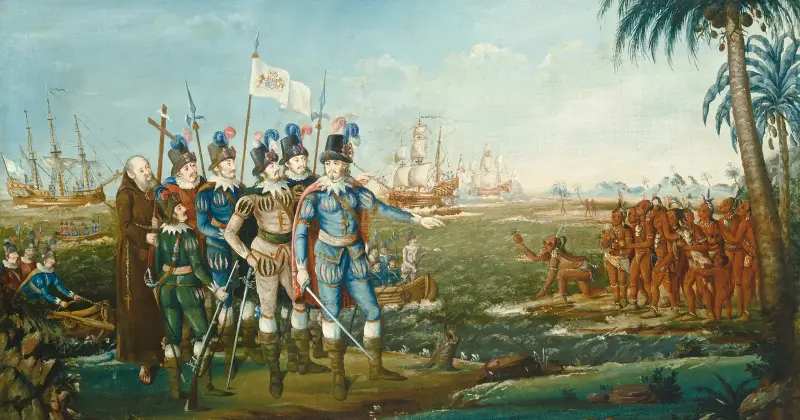
Half the ingredients in what most of the world now considers its national cuisine were, on 11 October 1492, on the opposite side of the planet from where they would eventually be eaten. The specific catalogue of foods that the Columbian Exchange — the term the American historian Alfred W. Crosby coined in his 1972 book of the same name to describe the two-way biological transfer that Columbus’s landfall initiated — moved from the New World to the Old World across the subsequent three centuries includes essentially every crop that a contemporary consumer of Italian, Irish, Swiss, Thai, Indian, Sichuan, Hungarian, Mexican-American, or West African cuisine would consider indispensable to the specific national or regional identity of that cuisine. Tomatoes (native to Mesoamerica; domesticated by the Aztecs, who called them tomatl) reached Spain in approximately 1521 with Hernán Cortés’s returning expedition; they took another 150 years to become respectable Italian ingredients (Italian aristocrats initially considered them poisonous, in part because they belong to the same nightshade family as several genuinely toxic plants). Potatoes (native to the Andes; domesticated by the Inca approximately 8,000 years ago) reached Europe with the Spanish in approximately 1570; they took another 150 years to become respectable European ingredients, and only became the specific Irish staple that would eventually make the 1845-1852 Great Famine possible after Sir Walter Raleigh introduced them to Ireland in approximately 1589. Cacao (native to Mesoamerica; used by the Olmec, Maya, and Aztec civilisations for at least 3,300 years as a ceremonial and elite beverage) reached Spain with Cortés’s expedition in 1519 and was not sweetened with sugar (which was itself a Southeast Asian crop that had reached the Americas only after the Spanish brought it there) or turned into a solid confection (which required 19th-century Swiss innovations that Daniel Peter and Rodolphe Lindt developed between 1875 and 1879) for another three centuries. Chili peppers (native to the Americas; every capsicum variety on Earth is descended from a small number of Mesoamerican wild species) reached Portugal in 1500, and Portuguese traders subsequently spread them to India, Southeast Asia, China, Korea, and West Africa across the following century — meaning that essentially every hot cuisine on Earth today, from Thai green curry to Sichuan hotpot to Hungarian paprika-based goulash to Korean kimchi, is post-1500.
According to Savory Spice’s historical retrospective on the specific culinary transformations produced by the Columbian Exchange, the substantive scale of the transformation was, by every reasonable measure of contemporary global food history, without precedent in the recorded history of the human species. Before 1492, Thai cuisine had no chilis; Italian cuisine had no tomatoes; Irish cuisine had no potatoes; Swiss chocolate did not exist; Hungarian paprika did not exist; Indian curry had no chili peppers (Indian pre-1500 cuisine used black pepper, ginger, and long pepper for heat); Sichuan cuisine had no chilis (Sichuan pre-1500 cuisine used Sichuan peppercorn and ginger for the numbing sensation the region’s cuisine is currently famous for); West African cuisine had no cassava or maize (both currently staple crops across the continent). The specific cuisines that most contemporary consumers of world food would identify as the most distinctively “authentic” — the ones that most seem to have emerged organically from the specific geography and history of their regions — are, in essential respects, all substantially post-1500 constructions that depend on ingredients that reached their current locations only because of the specific transatlantic mechanism that Columbus’s 1492 landfall initiated.
What went the other way
The exchange was, however, substantially two-way. As detailed in Britannica’s summary of the Columbian Exchange and its consequences for both hemispheres, the Old World’s contribution to the New World included wheat (which now grows across essentially the entire Great Plains of North America and the Argentine Pampas), rice (which became the basis of the Louisiana and South Carolina rice economies that later depended substantially on African slave labour), sugar cane (which produced the plantation economies of the Caribbean and Brazil that formed the substantive economic basis of the Atlantic slave trade), coffee (which became one of Latin America’s most substantial subsequent export commodities), bananas, citrus fruits, olives, and grapes. Every horse, cow, pig, sheep, chicken, and goat currently living in the Western Hemisphere is descended from Old World livestock that Spanish, Portuguese, English, and French colonial expeditions brought across the Atlantic between 1493 and 1750. The Great Plains bison-hunting cultures that dominated the North American West between approximately 1700 and 1880 were, in essential respects, entirely dependent on the reintroduction of horses (which had gone extinct in the Americas approximately 10,000 years ago and which the Spanish reintroduced in 1519) to the North American ecosystem.
What the exchange actually cost
The substantive cost of the exchange, borne substantially by the New World rather than the Old, is one that no adequate summary of the Columbian Exchange can fail to mention. Per the Bill of Rights Institute’s academic summary of the Columbian Exchange and its broader consequences, the pre-Columbian population of the Americas — variously estimated at between 50 and 100 million people in 1491 — collapsed to approximately 6 million by 1650 as a direct consequence of the Old World infectious diseases (smallpox, measles, influenza, typhus, cholera, malaria, yellow fever) that European expeditions carried with them across the Atlantic. The specific demographic mechanism is that Native American populations, having been genetically separated from the Eurasian and African disease pool for approximately 15,000 years, had essentially no acquired immunity to the pathogens that Old World populations had co-evolved with across the same period. The mortality rates in specific documented outbreaks reached 90 percent in some Native American communities. The Aztec Empire, which contained approximately 20 million people at Cortés’s arrival in 1519, was reduced by approximately 3 million people in a single 1520 smallpox outbreak that reached Tenochtitlán before the Spanish military expedition did. The specific foods that the New World gave to the Old World — the tomatoes and potatoes and cacao and chili peppers that would, across the subsequent five centuries, transform essentially every cuisine on the planet — travelled to Europe and Asia and Africa across the same trade routes that brought smallpox to the Americas. The single most consequential biological exchange in the recorded history of the human species was, in essential respects, catastrophically unequal.
The post Before Christopher Columbus crossed the Atlantic in 1492, Italian cooking had no tomatoes, Irish cooking had no potatoes, Swiss chocolate did not exist, and Thai cuisine had no chili peppers — each of those ingredients grew on a continent the other half of humanity had not yet found appeared first on Space Daily.