



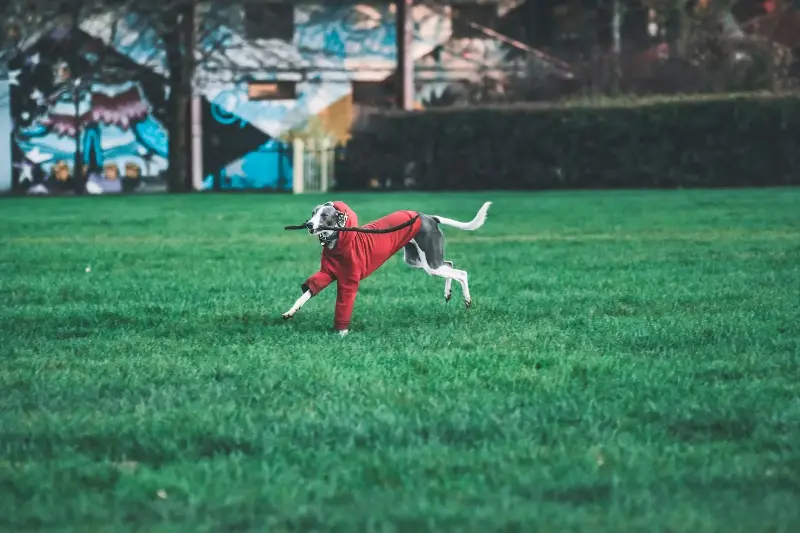
A whippet at full sprint looks less like an animal running than a spring being released. In a few strides, the small sighthound can surge from stillness to around 56 kilometres per hour, or about 35 miles per hour. That is not only because it is trying harder than other dogs. It is because, at top speed, it briefly stops being on the ground at all.
The key is the double-suspension gallop. In each full stride, a fast whippet has two separate aerial phases: one when the body is stretched long, and another when the spine folds and the legs are tucked beneath it. For those instants, all four feet are off the ground. The dog is not simply taking steps. It is launching, gathering, and launching again.
That gait is one reason whippets can produce such startling acceleration from a body that usually weighs less than many medium household dogs. They are not endurance machines in the way sled dogs are. They are short-distance specialists, built for explosive pursuit.
Two moments in the air
Most people picture running as a faster version of walking: one foot leaves, another foot lands, the body moves forward. A whippet’s sprint is stranger. In the double-suspension gallop, the dog goes airborne twice per stride cycle.
During one suspension phase, the front legs reach forward and the hind legs extend backward. The body is long, almost arrow-shaped. During the other, the spine flexes sharply, the hind legs swing forward under and past the body, and the dog compresses like a loaded spring. The next push begins from that coiled position.
Milton Hildebrand’s classic work on quadrupedal gaits helped formalise how scientists describe these patterns. Fast mammalian gaits are not just defined by which foot lands first. They are also defined by duty factor, flight phases, limb timing and the way the spine contributes to stride length.
For a whippet, that spinal motion is not a side detail. The back acts as part of the engine. When the animal stretches out, it lengthens the stride. When it folds, the hind feet can swing far forward, setting up the next launch. Speed comes from stride frequency multiplied by stride length, and whippets attack both sides of that equation.
The small greyhound problem
Whippets are often described as smaller greyhounds, and the comparison is fair in outline. Both are sighthounds: dogs bred to detect, chase and catch fast-moving prey by sight. Both have deep chests, narrow waists, long limbs, flexible backs and a body plan shaped around sprinting.
But whippets are not just scaled-down greyhounds. Their size gives them a particular advantage over very short distances. Less mass has to be accelerated, so the first few strides can be astonishingly quick. That is why whippets have a reputation for exceptional acceleration, even among fast dogs.
In American Kennel Club Fast CAT events, dogs run a timed 100-yard dash after a lure. Reported whippet performances around 35 miles per hour match the commonly cited 56 kilometres per hour figure. Those are competition speeds, not laboratory measurements under identical biomechanical conditions, but they show why the breed’s sprinting reputation persists.
The dog does not have to run for long to make the point. A backyard whippet chasing a toy may reveal the same pattern in miniature: the head drops, the spine begins to flex, the limbs disappear into a blur, and the body seems to skim across the ground rather than pound against it.
Muscle is only part of it
The obvious explanation for speed is muscle, and muscle matters. A 2007 study in PLOS Genetics found that a mutation in the myostatin gene, a gene involved in limiting muscle growth, was associated with increased muscle mass in whippets. Dogs carrying one copy of the mutation were overrepresented among elite racers, suggesting that the right amount of extra muscle could improve performance.
But the study also shows why speed is not simply a matter of being more muscular. Dogs with two copies of the mutation developed a very different, heavily muscled body type, often called “bully whippets”, and were not the same kind of racing ideal. Sprinting depends on balance: enough power to launch, low enough mass to accelerate, and a frame flexible enough to turn that power into long, fast strides.
The double-suspension gallop is where those traits meet. The hindquarters provide thrust. The forequarters catch, redirect and help pull the body into the next phase. The spine stores and releases motion. The legs do not merely cycle underneath the dog; they coordinate with a body that is alternately stretched and compressed.
That is why a whippet’s motion looks so different from a heavier dog trying to sprint. A stockier breed may push hard, but it cannot fold and extend through the same range or repeat the airborne phases with the same efficiency. The whippet’s advantage is mechanical, not just motivational.
Built for a short chase
This also explains the breed’s odd contrast at home. Many whippets are famously quiet indoors, content to sleep for long stretches. Then, given a safe open space and something to chase, they switch into a sprinting mode that seems out of proportion to their size.
That switch reflects their history. Whippets were developed as small racing and coursing dogs, prized for speed over short distances. Their job was not to trot all day beside a cart or pull through snow for hours. It was to explode after fast prey or a lure, cover ground quickly, and then recover.
The physics is brutally simple. At 56 kilometres per hour, a dog is moving more than 15 metres every second. Even a few seconds of acceleration can carry it across a lawn, a field or a racing lane. That is why safe containment matters. A whippet that has locked onto a moving target may be travelling too fast to respond the way an owner expects.
Seen in slow motion, however, the sprint becomes less chaotic and more elegant. The two flight phases are visible. The dog stretches, lands, gathers, launches, and stretches again. The ground is not something it stays on. The ground is something it touches just long enough to leave again.
That is the hidden trick inside the whippet’s acceleration. It does not beat other dogs only by moving its legs faster. It turns the entire body into a repeating leap, and every stride contains two moments where speed is carried through the air.
Sources
Milton Hildebrand, The Quadrupedal Gaits of Vertebrates, BioScience, 1989
Mosher et al., A Mutation in the Myostatin Gene Increases Muscle Mass and Enhances Racing Performance in Heterozygote Dogs, PLOS Genetics, 2007
Southern Living report citing AKC Fast CAT speed data
Southern Living report on AKC Fast CAT whippet performances
The Spruce Pets breed profile for whippet speed and breed background
The post A whippet can accelerate from a standstill to 56 kilometres per hour in just a few strides — not by running harder than other dogs, but by leaving the ground twice in every single stride appeared first on Space Daily.