



MINNEAPOLIS — The wildfires currently burning in the Boundary Waters Canoe Area Wilderness will eventually go out. Then the forest will begin to grow back, as it has always done.
If the past is any guide, that regrowth will ultimately help wildlife that feasts on the young, nutrient-rich saplings, berry patches and other forage as it returns to the landscape.
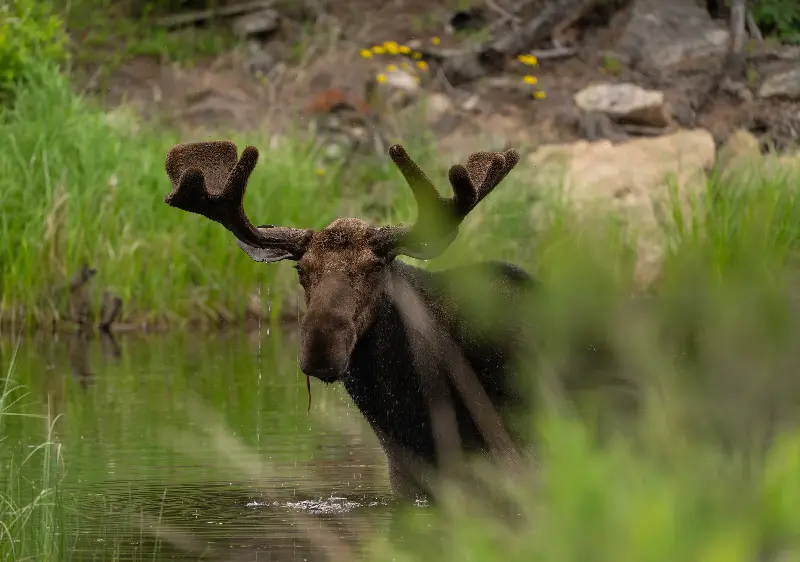
For Minnesota’s struggling moose population, the fires could bring an added benefit. Beyond improving the food supply, the flames could temporarily knock back parasites that have taken a toll on the herd.
Exactly when that help will come and how beneficial it will be depend on the intensity of the flames and on how many tall, old conifers are spared and left standing, said Amanda McGraw, a moose, deer and elk research scientist for the Minnesota Department of Natural Resources.
“What we’ve seen is it can take a while for the vegetation to start coming back if it was a really intense fire that knocked everything back to bare ground,” McGraw said.
The largest and most intense wildfire in recent state history was the Pagami Creek fire that started in August 2011 and burned more than 92,000 acres in the Boundary Waters. That fire, too, was started by lightning. Now, 15 years later, there are still parts of the Pagami Creek blaze that have not recovered, with bare rock and dead blackened tree husks. But the large majority of it has grown back, lush and green, with young red pines and jack pines, willows, aspens and blueberries.
“What these fires do is reset the forest to an earlier stage,” McGraw said. “So it becomes more of a young forest where you get a regeneration of highly nutritious food, whether it’s in grasses or forbs or trees or woody shrubs.”
It’s the ash that fertilizes the regeneration. That ash is packed with nitrogen and other nutrients from all the trees that are burned and brings it back into the soil. With the forest cleared, direct sunlight gives young plants a chance to grow.
“You get this pulse of vegetation that’s highly nutritious,” McGraw said.
The northern forest depends on fire to bring about regrowth, and so do the animals in it.
Parasites perish
The sweet spot for moose, which have been struggling in Minnesota, is typically 3 to 10 years after a wildfire, McGraw said.
That’s when new aspen and paper birch trees are young and short. The same goes for sun-loving fire cherry, mountain maple and ash trees. After about 10 years those trees are typically too tall to provide moose any food.
But moose cannot live on young trees alone. They need cover, especially old evergreens in low lying swamps or wet patches where they can keep cool in the summer. They do best when the branches of those conifers are big enough to interlock and form into canopies that can keep some of the snow off the ground in the winter, McGraw said.
Each fire behaves differently. The hope is that the flames jump and skip over enough pockets of old conifers that moose will have cover and shade nearby as they head into the new young growth to browse, she said.
Moose calves were plenty old enough by July, when the current fires started, to keep out of the path of any flames or smoke, McGraw said. But their two biggest tormentors, both parasites, cannot outrun a wildfire.
Minnesota moose have been beset in recent years by winter ticks, which burrow into them by the thousands and slowly bleed them into anemia or leave their coats so bare that the big mammals can die of exposure in the winter.
Moose have also been killed by a parasitic brainworm that is carried into moose territory by whitetail deer. The parasites pass through deer scat and are scooped up by snails and slugs. The moose unknowingly gobble up the snails while eating leaves or other vegetation off the forest floor and become infested.
While the fires won’t permanently lower tick or brainworm populations, it’s possible they will burn up a great deal of the parasites this summer and fall, McGraw said.
“We haven’t gotten to measure this yet, but we think there’s a chance that it might really knock down the tick population and these terrestrial snails at least for a year or two,” she said.
McGraw said she hopes to work with citizen-scientists, volunteers and hunters to check trail camera footage of moose in the area in the coming years to see how their coats look.
Berries and bears
What’s good for moose is almost always good for deer, songbirds, grouse, black bears and a host of other species, which rely on a similar mix of young vegetation for food and old growth for cover.
For bears, it’s the raspberries that are typically the first wild fruit to grow back after a fire, said Andy Tri, the bear project leader for the DNR.
Then come waves of blueberries, juneberries and chokecherries, he said.
As with tree saplings, the exact timing of berry regeneration depends on the intensity of the flames, Tri said.
In the first year after a moderate fire, blueberry production is normally low, he said.
But that’s followed by two to three years of excellent berry production.
“And then it starts to taper off,” he said.
Once berries are established, it doesn’t take long for bears to find them. And once they find them, they will come back year after year.
“They are super smart critters with really good noses,” Tri said. “They evolved to remember exactly where the berry patches are because they need those high-density calories.”
Tri said black bears start showing up to the site of some fires even before berry patches get a chance to start growing.
So long as there is a bit of rain and even a little underbrush, he said, there’s a good chance a bear will be nearby looking for something green to munch on.