



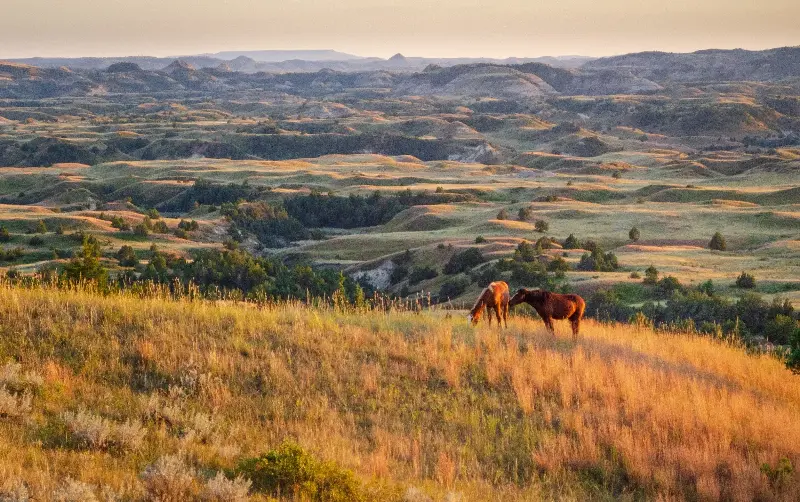
Storm clouds tapered off over the Great Plains of North Dakota. A trio of wild horses emerged on the horizon, trotting through the mixed-grass prairie of Theodore Roosevelt National Park, still glistening with fragrant summer rain. It was a landscape delivering Americana at its purest: billowing grasses peppered with confetti-like wildflowers, and petrified logs shimmering with silica strewn like bejewelled boulders amongst rugged badlands and buttes.
As I hiked the Petrified Forest Loop, a 10.4-mile trek through the remote wilds of the park’s south unit, I found myself humming Home on the Range. Here, in the sweeping solitude of one of the United States’ least-visited states – and least-visited national parks – I found a place where the buffalo roam, where the deer and the pronghorn play, and where the clouds part over meandering rivers and grassy plains.
It was my first trip to Theodore Roosevelt National Park. Within moments of driving into the park that morning I had pulled over, ceding the road to a bison as large as my hire car. Now out in the elements, between the lush remnants of a summer storm and the wild horses pausing to stare me down as I crossed their path, I was at once soothed and humbled.
This wilderness has inspired people – from Indigenous nations to presidents – for centuries. The Mandan and Hidatsa tribes, and later the Arikara, hunted bison here. Living in earth lodges along the Little Missouri and Knife rivers, the Three Affiliated Tribes, as they’re collectively referred to, thrived in this region.
Today, those tribes mostly reside on the Fort Berthold Reservation about 81 miles east of the national park’s north unit, where visitors can witness powwows – such as the Four Bears Powwow and Little Shell Celebration – that keep Native traditions alive through competitive dancing, beaded regalia and singing in the tradition of Northern Plains tribes (distinguished by high-pitched tones and thunderous drum strikes). You’ll also find arts and crafts, and foods such as bison stew and frybread, a traditional fried flatbread.
Theodore Roosevelt, the park’s namesake, felt that same reverence when he first visited in 1883. While serving as a member of the New York State Assembly, he voyaged to pre-statehood Dakota Territory to hunt bison. What resulted was a love story about a landscape. Describing his time here as the romance of his life, Roosevelt said he would not have become president had it not been for his experience in North Dakota.
The region’s sense of calm and quiet beauty provided refuge and instilled in him a passion for conservation that he brought to office, helping to pave the way for the National Park Service and, during his presidency, inspiring him to establish dozens of national parks, forests, monuments and wildlife sanctuaries, protecting 230 million acres of land.
Elkhorn Ranch, the cottonwood timber abode he used as a retreat from city life in the 1880s, is in the middle of the 110-square-mile park, accessible via gravel roads that run between the park’s north and south sections – and between two time zones. It’s a place of utmost serenity, on the banks of the serpentine Little Missouri, where bison and golden eagles far outnumber the people.
In the park’s southern gateway town of Medora, you’ll find more of a modern memorial at the Theodore Roosevelt Presidential Library, which opens on July 4, 2026 – aptly, on the 250th anniversary of American independence. The state-of-the-art museum drew inspiration from the “Conservation President” in its sustainable design and architecture crafted to blend in with the surrounding buttes.
Medora is also home to unique stays, such as frontier-era Conestoga pioneer wagons, the Western-themed Rough Riders Hotel complete with one of the largest libraries of books by and about Theodore Roosevelt and, also new for this summer, Hotel 1883, which offers widescreen-esque views of the badlands.
A 36-mile scenic drive runs through the south section, along with numerous hiking trails through terrain that looks more like a grassy Mars than North Dakota. In the park’s quieter north, a 14-mile drive weaves through badlands – and, most likely, herds of bison – before scaling a canyon rim for sweeping views of the River Bend Overlook.
Other activities in the park include cycling, horse riding, cross-country skiing in winter (which brings an average of 76cm of snow and temperatures of -18C) and paddling the Little Missouri river (a multi-day trek if you’re doing the full 106-mile stretch).
At night, thanks to its pitch-black skies, the park is one of the best places in the continental US to see the Northern Lights, particularly during the winter months. And at any time of year, visitors with their eyes on the skies can clearly spot the Milky Way, Jupiter’s moons, meteor showers and other astronomical wonders. The Dakota Nights Astronomy Festival takes place in the park from Aug 14-15 this year, featuring stargazing, discussions about the aurora borealis and edible “marshmallow constellations”.
As I walked through petrified forests and badlands where bison, elk and wild horses roam, I was struck by the same wonderment that enthralled the United States’ 26th president. “I grow very fond of this place,” he once said. “It has a desolate, grim beauty of its own, that has a curious fascination for me.”
I may not be a president, but I too left a changed man. In Theodore Roosevelt National Park I traced in the footsteps of giants, from a political and conservation pioneer to the largest land mammals in North America. Beside the Little Missouri, trickling slowly between canyons on its steadfast march towards the horizon, there’s a quiet yet staggering beauty that washes over you.
That trail, through windswept grasslands perfumed with fresh rain, is still as deeply affecting today as it was back then.
Essentials
The nearest big city and regional airport to Theodore Roosevelt National Park is Dickinson, around half an hour’s drive away. Fly to Dickinson or Bismarck with Virgin Atlantic, Delta or United Airlines, via Minneapolis or Denver, then pick up a hire car.
The park is most easily accessed via the southern unit, from the gateway town of Medora, where you can stay in cabins, glamping sites and hotels, and arrange horse-riding and other activities.