



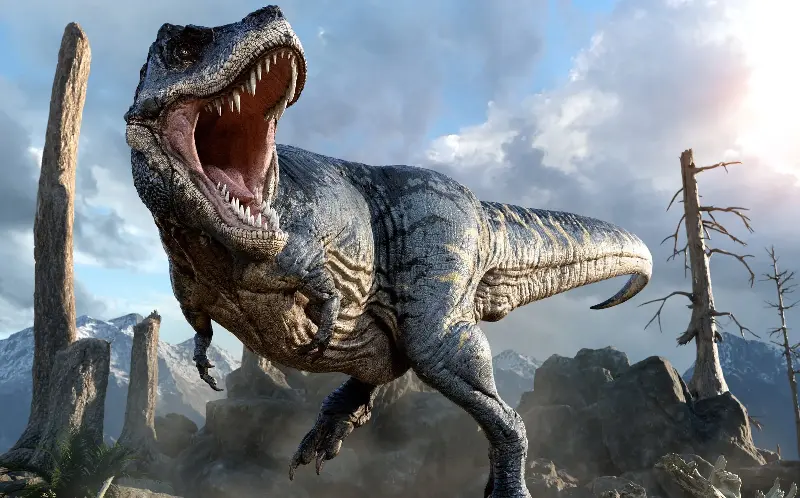
The tiny arms of Tyrannosaurus rex have supplied cartoonists and comedians with endless gags since its discovery, but the giant dinosaur may have had the last laugh.
A new study suggests meat-eating dinosaurs such as T-Rex evolved such small appendages because their terrifyingly huge heads meant they no longer needed powerful claws to rip into prey.
Experts at University College London (UCL) and the University of Cambridge studied data from 82 species and found smaller arms were closely linked to the development of large, powerful skulls and jaws.
The researchers believe that the evolution of gigantic sauropods, such as Alamosaurus, and other large herbivores, may have resulted in a shift to hunting using jaws and heads instead of claws.
Charlie Roger Scherer, a PhD student at UCL Earth Sciences, said: “Trying to pull and grab at a 100ft-long sauropod with your claws is not ideal.
“Attacking and holding on with the jaws might have been more effective.
“It is highly likely that strongly-built skulls came before shorter forelimbs. It would not make evolutionary sense for it to occur the other way round, and for these predators to give up their attack mechanism without having a back-up.”
‘Use it or lose it’
Therapods, a major branch of dinosaurs with three toes, found themselves in an “evolutionary arms race” to develop better methods of subduing the large beasts, losing what they did not need along the way, the experts believe.
Mr Scherer added: “It’s a case of ‘Use it or lose it’ – the arms are no longer useful and reduce in size over time.”
Many of the giant theropod dinosaurs also evolved relatively small forelimbs, with the Carnotaurus having arms even smaller than those of the T-Rex.
Researchers found the evolution of small arms mostly occurred in areas where large prey roamed. They believe that the head gradually took over from the arms as the prime method of attack.
The team developed a new way to quantify skull robustness, based on factors including how tightly connected the bones of the head were, the dimensions of the skull and bite force.
On this measure, the T-Rex scored highest, followed by the Tyrannotitan, a theropod nearly as massive as T-Rex, that lived in what is now Argentina in the Early Cretaceous period – more than 30 million years earlier than T-Rex.
They found that reduced forelimbs had a stronger link with skull robustness than with skull size or overall body size.
Previous studies have suggested that T-Rex may have evolved its tiny arms to aid balance or to help it stand upright again after taking a tumble or holding a female during mating.
The latest study was published in the journal Proceedings of the Royal Society B.