



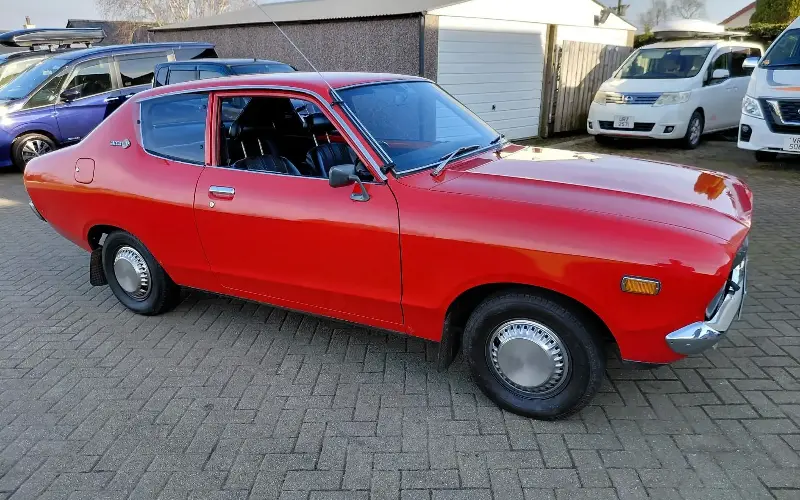
Andrew Smyth’s 120Y Sunny Automatic looks so immaculate that it appears to have time-warped from a Datsun showroom in 1975. You half expect its radio to start blaring David Essex’s Hold Me Close and the glovebox to contain a bottle of Blue Stratos aftershave. Today, only three 120Y Automatics are believed to remain on the road, although in its heyday this model was a major threat to the dominance of UK-built cars.
Smyth bought the 120Y sight unseen in 2009. “It was advertised on the Datsun Owners’ Club forum. A young guy was selling it on behalf of his grandad from York, who had owned it from new but could no longer drive. I made an opportunistic offer of £1,000, which was accepted. I sent cash with a car transporter driver with instructions to buy it only if it was as good as described. He phoned me to say that the 120Y was every bit as good as described, so the deal was done.”
This newspaper noted that when Nissan introduced the 120Y, the third-generation Sunny, in August 1973, the company “took the lead among importers in Britain”. UK Nissan sales, under the Datsun name, began in 1968, when the concessionaire registered a batch of six cars. Four years later, the company embarked on an elaborate campaign to attract new dealers, many of whom were former British Leyland franchises.
In 1974, the UK concessionaire Octav Botnar told The Telegraph: “Technical advance is nonsense. The customer wants a car that he can be 100 per cent sure of, that he doesn’t have to spend a lot of money on.” The 120Y encapsulated his philosophy. It may have resembled a scaled-down US-market Plymouth and featured a jukebox-like fascia, but there was nothing about its 1,171cc engine and rear-wheel-drive layout to frighten the average suburbanite.
Datsun sold the 120Y as offering “first class, comfortable motoring at a sensible price” and by 1975 the two-door 120Y in manual gearbox form was £1,430. This compared very favourably with the £1,453 Ford Escort Mk2 Popular Plus, which lacked the Datsun’s reclining front seats, cigarette lighter, tinted glass and radio. A Datsun dealer might also note that the entry-level Vauxhall Viva two-door was £123 more expensive than the 120Y and was even devoid of rear ashtrays and an interior bonnet release.
As well as allowing the owner to listen to Radio 4, the 120Y was probably more likely to start first time than some British rivals. In 1975, Datsun UK boasted sales of more than 200,000 due to “reliability, economy, ‘no-cost extras’; the sheer value for money of Britain’s best-selling imported cars”. Smyth remarks: “The reliability, the standard of build quality and level of equipment were something that British drivers hadn’t experienced before.”
The B310-series Sunny replaced the 120Y in 1977 after more than two million units. Their limited survival rate in this country – only 42 of all types are believed to still be in use – is no surprise due to the age-old problems of corrosion and the Sunny being often regarded as a disposable consumer good. Today, Smyth finds that “everywhere I show my 120Y, everyone has a story to tell about owning a Datsun”.
The 120Y is now part of Smyth’s fleet of rare Datsuns in Northern Ireland, which includes a 100A and an equally rare Cherry 120A Coupe. “I got a lovely letter from the grandad telling me how to care for the car and wishing me every luck with it. With only 20,000 miles and undersealed from new, the 120Y is in amazing timewarp condition. Every little detail is period correct and it’s obvious that it has always been cherished.”
As for driving the 120Y: “Compared with a modern car, you absolutely know you are driving the Datsun and you are in control, as there are no nannying driver-assistance features. There is no power steering, the choke is manual, you have to push the brake pedal hard to get a meaningful effect and it has keep-fit window winders. But I love driving it and really cherish the tactility of every control. The engine purrs like a sewing machine and never fails to start.”
In October 1973, Autocar presciently observed: “The new 120Y Sunny from Datsun is bound to cause the home industry a lot of headaches.” By early 1975, the 120Y had helped Datsun become the country’s fourth best-selling car brand after British Leyland, Ford and Chrysler UK, beating Vauxhall into fifth place. And 51 years later, Smyth’s two-door is a reminder of the model that inspired so many Britons to buy Japanese.
And in his words: “It is wonderful to drive a car from the 1970s that’s almost like it was brand new.”
We use the fascinating howmanyleft.co.uk for figures of surviving examples, but some cars present more of a challenge than others, so the figures are rarely authoritative. Some pre-1974 records were lost before the DVLA centralised the process, while some cars have their model type misnamed on the V5 vehicle registration documents. A further issue is the omission of the exact model name or generation, or distinction between saloon and estate bodystyles.