



“Optimism is a skill – and you can learn it at any age,” declares Gyles Brandreth, 78. One study, he tells me, found that optimistic 85 to 90-year-olds lived five years longer, while another found a negative mindset about ageing could cut life expectancy by up to seven and a half years. “That’s quite a swing – based purely on how you think about your future self.”
A diehard optimist himself, Brandreth, writer, broadcaster, national treasure, and proud wearer of novelty jumpers, is telling me how he plans to live to 100. He favours achievable habits, including five-minute exercise snacks, a colourful and lighter diet, earlier meals and time outdoors before using screens.
Our chances of living to 100 are better than ever before, he explains. The number of people reaching 100 has surged from roughly 23,000 a century ago to nearly 722,000 today (a total expected to hit four million by 2054). But with so much noise and contradictory advice, it’s hard to give ourselves the best possible odds.
So he’s written a book (his 64th), The 7 Secrets of the Hundred Year Life, a mix of hard science and practical advice. It’s co-written with his physiotherapist, the charming Finola Burrell, 35, who has also worked with Mick Jagger and Stephen Fry.
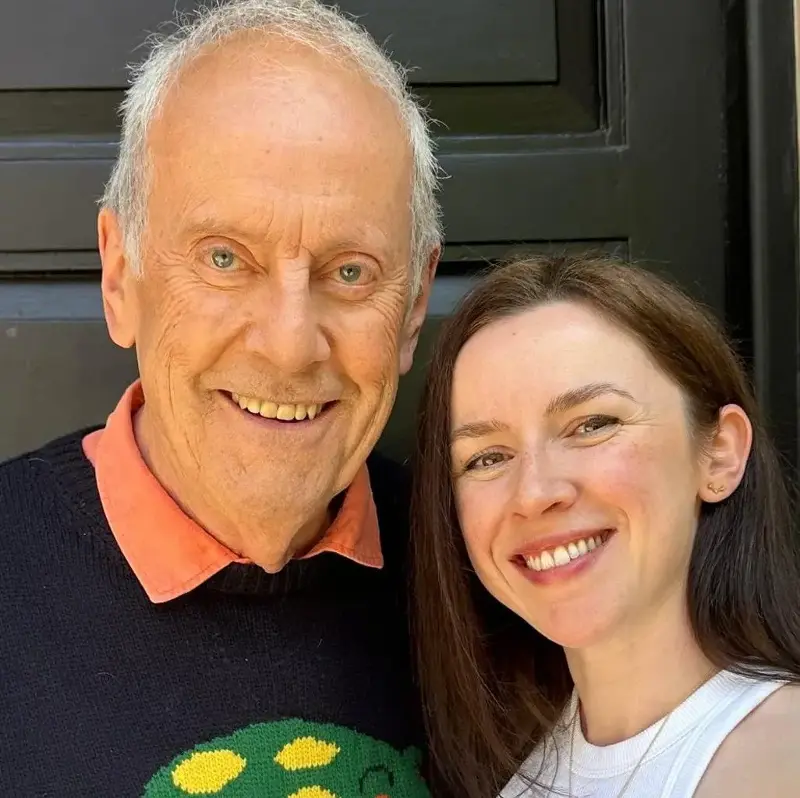
It’s a yin and yang relationship. Burrell, a physiotherapist for 15 years, focuses on the body, while “optimistic amateur” Brandreth is good on age-proofing your mind. “I’m very good at attitude, the power of positivity. What I’m less good at is the diet, and the exercise, and the drinking of the water. These are not of interest to me,” he says loftily. Though Burrell has taught him to drink eight or more glasses of water a day (after 65, hydration is even more critical).
Shuffling is banned
They first met when at age 74 he fell over and broke his arm, snapping the humerus. “It was a real wake-up call.” An exercise refusenik since childhood, he realised he had focused on nourishing mind and spirit, but neglected his body.
In fact he’d been tripping over for several years, once bringing his poor wife (author Michèle Brown) crashing down so hard she broke her wrist. Another wake-up call was when he was mistaken for a frail Joe Biden on a visit to Ireland. “You may laugh; it wasn’t funny at the time.”
He was introduced to Burrell, who specialises in treating older patients. She taught him that staying upright is all about strength, balance and coordination. The trick is to build muscle and strength. And better late than never.
“Shuffling is banned,” Brandreth shakes his head. It feels safer but is counterintuitive because it makes you more likely to trip. “Finola tells me to stride like I think I’m the best thing since sliced bread.” Together they also devised a new exercise, diet and sleep regime for him. Brandreth hasn’t fallen over since.
Don’t look down, don’t look in
Brandreth is a self-described stiff-upper-lip type. “One thing I learnt from the Duke of Edinburgh [the late Prince Philip, with whom Brandreth is connected through years of charity work], and he was very hot on this, was: ‘Look up, look out, don’t look down, don’t look in.’ He gave all his children the same advice, which is never talk about yourself. Always ask other people questions. Let them tell you about themselves. They’re not interested in you.” But as a younger person, Burrell takes mental health and self-care seriously. So through her he’s learnt the value of opening up, and practising a bit of self-compassion.
Brandreth wants us to engage in mentally stimulating activities to build cognitive reserve: “play music, do puzzles, learn a language”. This is something he’s learnt first hand, from a handful of well-preserved friends. He’s certainly known a lot of centenarians – from the founder of his school, Bedales, John Haden Badley – they played Scrabble when Brandreth was a teenager and Haden Badley, in his eleventh decade, invariably won – to his close friend today, actress Thelma Ruby, 101. “She told me that in 100 years she could not remember losing her temper once.”
Have a set morning routine
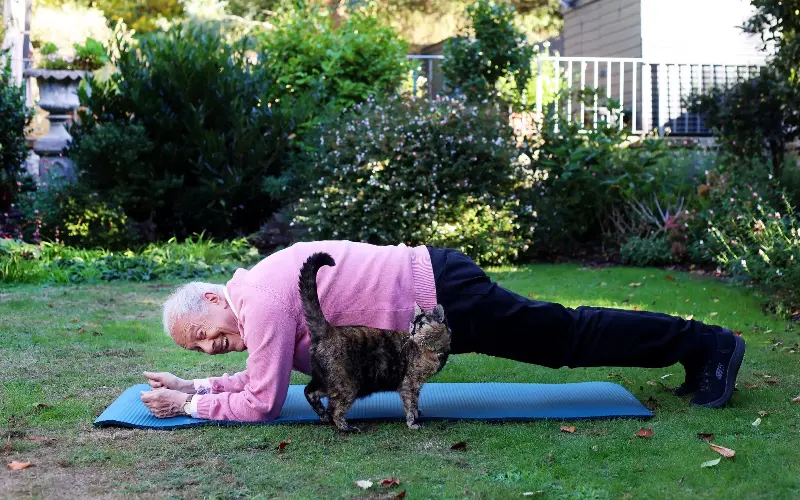
Burrell loves habit-stacking, while Brandreth believes in a positive attitude. “The first thing I do is not sigh. I get out of bed with a spring in my step, and go down to make my tea and my wife’s coffee. The cat wants to go out so I step into the garden, rain or shine.” Daylight reduces stress and gives you a calm start before digital notifications demand your attention. “I make sure I’m getting my blue sky before the blue screen.”
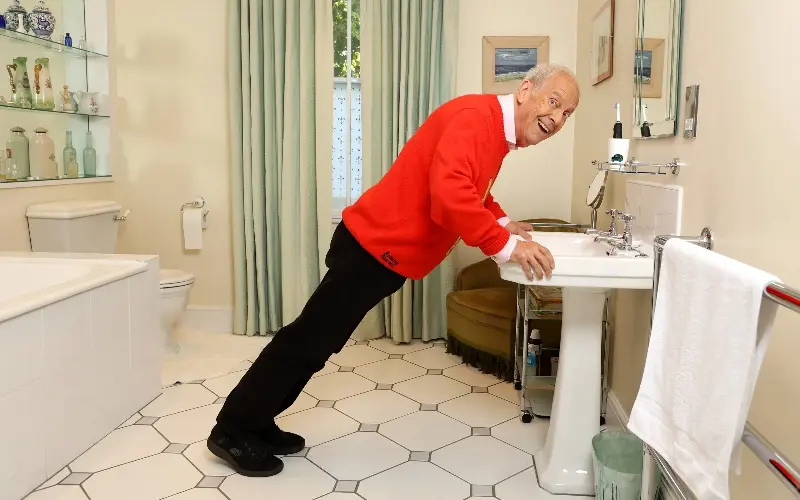
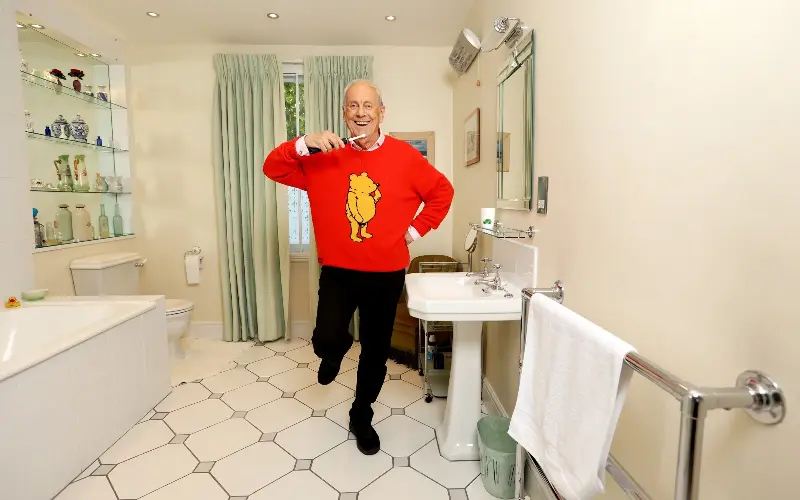
Because he’s a workaholic, Burrell has taught Brandreth to integrate physical exercise into daily life. Brandreth’s day starts with a five-minute bathroom exercise routine involving 15 push-ups against the basin (so he can push up off the floor if he ever falls), lunges for leg strength, heel raises for power when walking, and standing on one leg while brushing teeth for balance.
Brandreth is proud he can now hold a plank for a minute. “At the start I was collapsing after 10 seconds.” He has rewards to keep him motivated. “I can listen to the radio while it’s happening, then I text Finola to tell her I’ve finished. She is always up because she’s just had a baby. Then she sends me a little clapping hands icon. If don’t text her, I get a question mark! So we have an emoji relationship.”
It’s not about perfection, he insists. “You can be a fitness buff if that’s your game. But if you aren’t, you can just do the fitness snacks.”
Even at 80, we can have more snap in our celery, he laughs.
Eat the rainbow
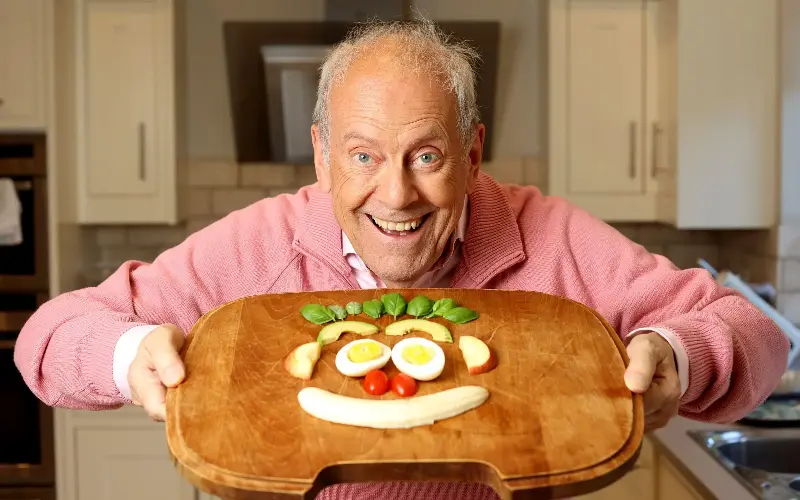
Brandreth eats a vegetarian, carb-free diet (no bread, rice, pasta, potatoes) so breakfast is a hard-boiled egg, cheese, tomato. “But I make it look nice on the plate, and because I’m optimistic, I cut the egg in half so that it becomes the two eyes and the tomato is the nose. If I’ve got a piece of melon or avocado, that becomes the mouth. So I give myself a smiley, colourful plate.” In the car on the way to film ITV’s This Morning or when he records his podcast Rosebud (where he questions celebrities about their childhood memories), he eats a boiled egg or a piece of cheese “so I’m not tempted by the pastries.”
“What I like about Finola is she’s totally anti-fad. She said: ‘Don’t worry if you don’t live in a Blue Zone [countries renowned for their longevity]. Just make sure you’ve got a colourful plate of food. If you’ve got lots of orange, yellow and red on your plate, you’re eating a good diet, full stop.’ It’s all very simple stuff.”
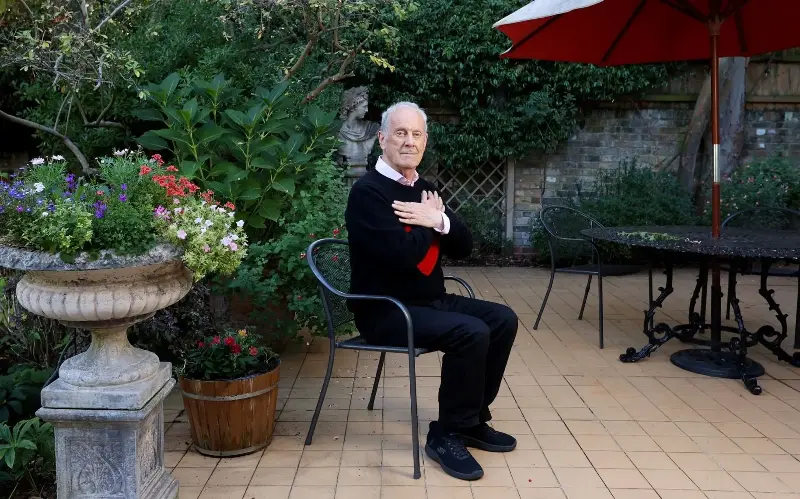
Michèle is no longer interested in cooking and he admits they are “microwave-meal people”.“We make a lot of meals from a company called Cook. You can have indulgent things like cauliflower cheese, but add pulses, beans and wholegrains and steamed veg.” Brandreth obeys the 80 per cent rule: only eating until he is 80 per cent full rather than completely full. “One of the tricks is to serve the food, then put 20 per cent back.”
He gave up alcohol more than 25 years ago when he was an MP, to lose weight. But the couple have a 6pm sundowner together where he downs a Fortnum & Mason sparkling tea, because ritual is important. “It’s as expensive as champagne,” he laughs.
Relationships are one of your strongest medicines
Human connection is the key to a long life, Brandreth stresses. It’s important to stay socially engaged. He has three children, seven grandchildren and believes strongly in multi-generational friendships, citing his friendship with Finola. “I’m older than her dad. I may even be as old as her grandfather, which is quite interesting.”
Quite simply, other people keep us well. “You have to be a leaf on a tree, by which we mean attached to an organism that is larger than yourself and still growing. A leaf feels independent, but quite quickly it floats to the ground and dies. People need people, and for older people, this is a particular challenge. Phone and Zoom calls are fine. But actually, you need eye-to-eye contact. You need somebody to come round to play a game of Scrabble, or go on a walk. That’s why people should join a choir or a book club, do bell ringing. You need other human contact. The death of the local pub has been a big thing for men. You know, people offer to volunteer; they come round and want to do the shopping for you. Well, actually, what you want them to say is: ‘Let’s go to the shops together.’”
Have a sense of purpose
“The rules for being happy are really quite straightforward,” Brandreth insists. “You need a purpose beyond your work. Don’t resent or resist change. If you are fearful of change you can’t be happy. Live now – and you will live longer. The late Queen was a good example, driven by duties sustained by faith. But what helped her live so long was her passion for her dogs and her horses.
“At 80, life is not a dress rehearsal,” he says more seriously. “Audit your happiness. Ask yourself what are my passions? It does require some attention. One of my favourite sayings is ‘Don’t dabble, focus.’ You’ve actually got to focus on each of these elements: what is my purpose, who are my companions, what is my diet, my exercise routine?”
What does he wish he’d known when he was younger? “When I became an MP in 1992 I was given a saying by Arthur Balfour, who had been prime minister 100 years ago: ‘Nothing matters very much, and most things don’t matter at all.’ So I think I’ve learnt the light touch. When anything grim comes along, I think: this too will pass. But also I’m very lucky because I’m still very busy. In fact, I’m busier than I’ve ever been. It’s not how you start; it’s how you finish.”
So confident is he about the new book, that “I’ve put my money where my mouth is. There’s a clause in the contract that requires me to repay the advance if I don’t reach my 100th year. By then inflation will have eaten away at it, but I wanted to show commitment to the plan!”
The 7 Secrets of the Hundred Year Life: A practical guide for living well for longer (Octopus Books, £16.99) by Gyles Brandreth and Finola Burrell is published on Oct 15