



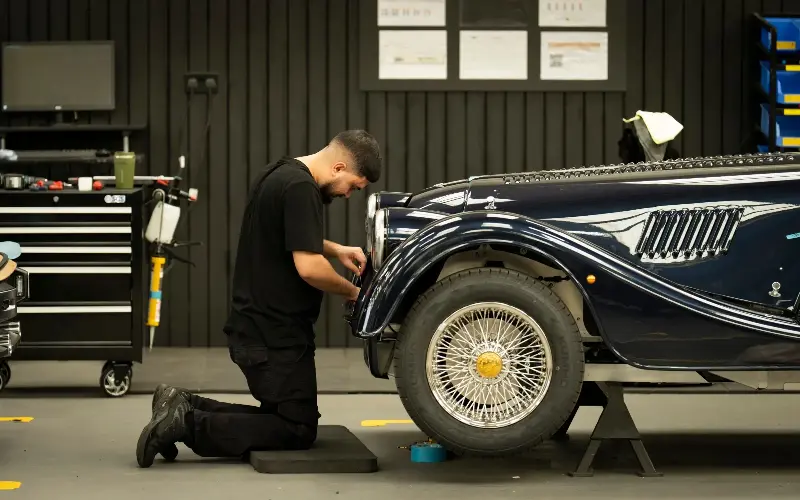
In the sawdust-scented air of Morgan Motor Company’s factory, part of the Malvern headquarters where the company has been producing ash-framed sports cars since its founding in 1910, 23-year-old Hamish Cameron-Eveleigh tells me how he fell in love with the cars made by a firm that was, until 2019, the oldest privately owned car manufacturer.
“My grandad raced Morgans, and my uncle raced them too. I remember going for drives with my grandad and my mum, who also has a Morgan.” But Cameron-Eveleigh isn’t just another Morgan fan I’ve met during the guided factory tours. He’s a sheet metal shop technician with the firm. “I first visited the factory when I was young, and I always wanted to work here,” he tells me in the assembly shop. “I started here with a four-year apprenticeship.”
Keeping it in the family
Whether he will rack up as many years as his fellow sheet-metal worker Martin Cole remains to be seen. “I started in 1977, aged 16,” says Cole. “My father worked here for 56 years, my brother has worked here for 42 years and my son has worked here for 12 years. As a family we’ve probably worked here for longer than Morgan has been around.”
Cole has fond memories of Peter Morgan, the late chairman and son of the company’s founder, HFS Morgan. “My interview was with Peter,” recalls Cole. “He was a proper Morgan man. He drove one to work and he would walk the factory floor every day, chatting to staff.”
Hand-building tradition
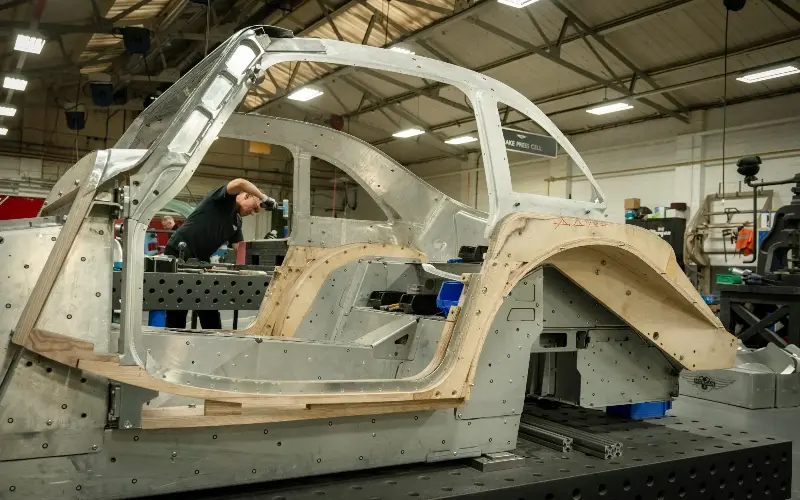
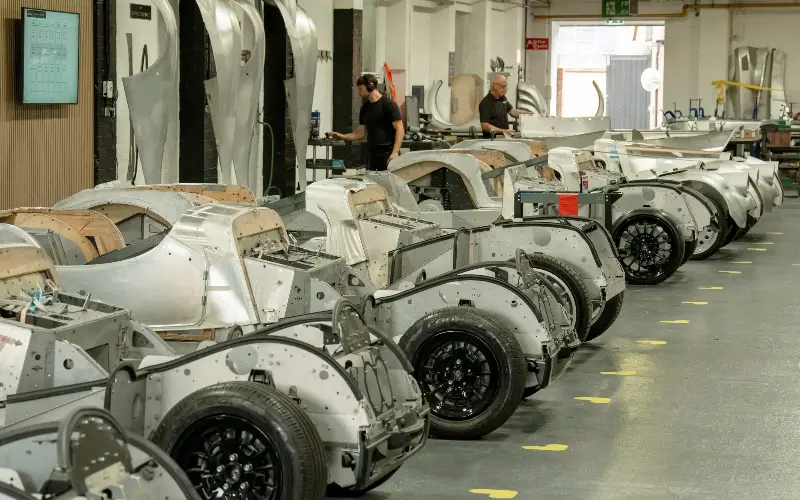
It’s far removed from the robotic precision of modern car factories. We talk to a soundtrack of clanging hammers, a reminder that every Morgan is still handmade in a complex of buildings dating back to the early 1900s.
Though acknowledging that there have been changes, Cole says the overall approach hasn’t altered much. “When I first started we put our patterns on the metal, drew around them and cut them by hand. Now we use laser cutting, which is a good change – for me, the hardest job was panelling the car by hand.”
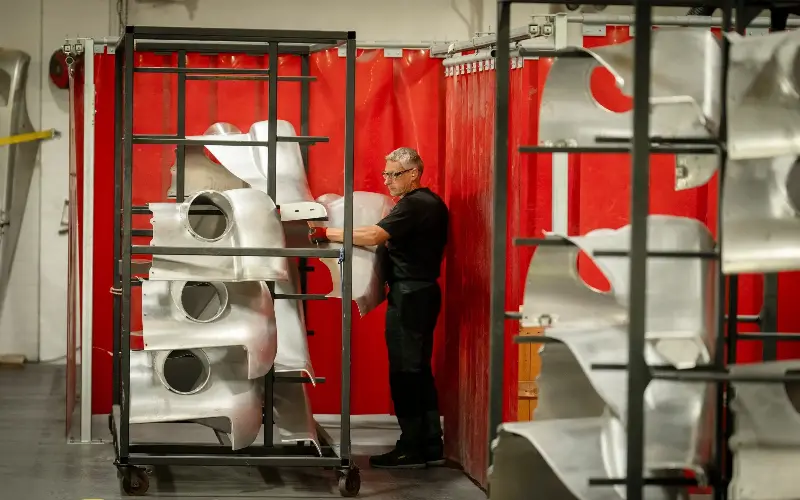
It’s not only the people who have fascinating stories; the tools of their trade are similarly rich in history. “I got these Gilbow snips in 1977,” says Cole, fishing out a fearsome-looking pair of metal-cutting shears. “They’ve been sharpened a few times, but that’s it.” He points out 100-year-old presses nearby, along with rollers for forming the cars’ sheet-metal bodywork that were made in the 1920s.
Infamous waiting lists
The cars aren’t for everyone, but drivers who want a Morgan really want one. Because of the relatively slow hand-building process, during the 1990s impatient clients would pay to swap places with people frther up Morgan’s notorious eight-year waiting list. That has fallen to between six and 12 months, thanks to improved production processes, including the aforementioned laser cutting.
What hasn’t changed is the intersection between design and craft. Recently, a regular customer approached Morgan to ask whether it would make him a coupé, which hadn’t been done before. It was decided nine would be made. The client’s friends placed orders, and all were sold before the press release announcing that the Midsummer Coupé had been released.
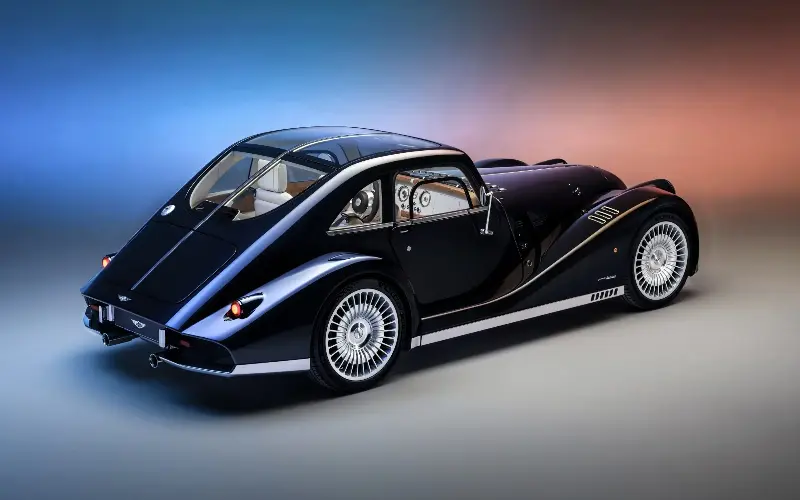
The Italian supercar design studio Pininfarina (the geniuses behind many Ferraris) was tasked with styling the Midsummer Coupé, and about 50 designs were pitched before Morgan settled on a coupé with a glass roof. Pininfarina’s design team wanted to expose the car’s traditional ash frame to which the bodywork is attached, but wasn’t sure how.
The knowledge and experience of Dave Young, a wood laminating technician who honed his skills over decades working with different types of wood, first as a bespoke furniture maker and then at Morgan, proved essential. “For certain bits they suggested using solid wood, but I explained it wouldn’t be strong enough and that there would be a lot of colour variation, so it needed composite material or lamination,” says Young. “The lamination we used also helped make the wood colour more consistent.”
Jade inlays and ostrich leather
Many details relating to the Midsummer Coupés are off the record, but I can reveal that its 400bhp engine helped it outpace a Lamborghini in a track testing session. “It feels similar to driving a supercar,” says the Midsummer Coupé’s engineering project lead, Dave Edwards (a Morgan fanatic who purchased his Morgan Roadster, and whose wife purchased her Morgan Super 3, long before he started working here).
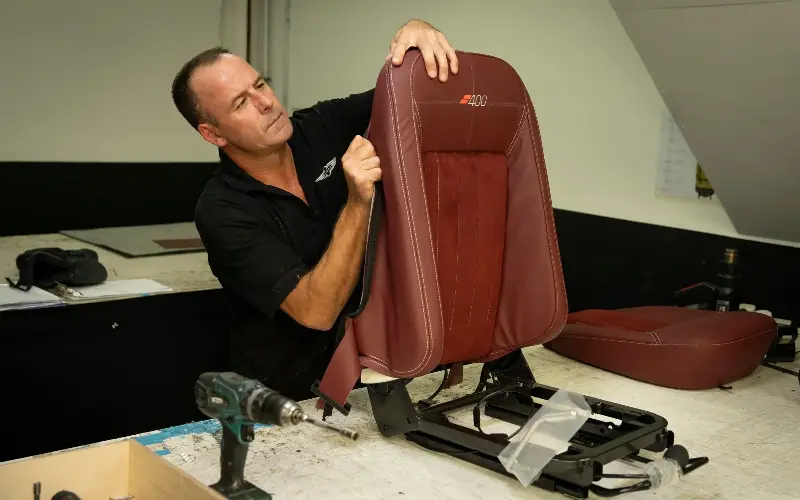
He says the groundbreaking design called for a shift in thinking: “It wasn’t just about sticking on a roof” to the traditional roadster body. Everything from the chassis to the metal skin needed to be designed and balanced in a different way. “The roof only adds 25kg but almost doubles the chassis’s stiffness,” he says.
I learn that one of the nine coupés has an ostrich-leather interior, while the dashboard of the one I see in the special-projects workshop will have a jade insert, engraved with the owner’s initials, a reference to his business deals with China, where traditional signature stamps were once carved from jade.
Fancy a pink Morgan?
Ostrich leather is far from the most unusual material to be specified in the bespoke builds. “The customisation requests are certainly more eccentric than ever,” says Henry Baker, Morgan’s head of communications. “One customer once ordered a Morgan Plus Four with hot-pink mohair on the roof’s interior and exterior.”
Not that hot pink doesn’t sell. Although it didn’t work for Jaguar with its controversial concept for a battery-powered grand tourer, next to the visitor centre is a Morgan Super 3 with a bright-pink paint job. Sadly, the client who commissioned it changed his mind once he clapped eyes on it. Fortunately for Morgan, there’s never a shortage of people eager to bypass the waiting list – even if the car is hot pink – and it has now been resold.
Also next to the visitor centre is a huge, sleek glass box, often with a Morgan inside. Many clients collect their cars from dealerships, after occasional visits to the factory to check on the progress (in the case of the Midsummer Coupés, some arrived by helicopter with security teams in tow), when they will often ask engineers to sign wooden parts of the unfinished car. When clients collect their car from the factory, their finished product will sometimes be placed in this box, displayed like a priceless Rolex. Suddenly the thought of collecting my next car from a ubiquitous edge-of-town showroom seems rather depressing.
On my way out, I pass the heritage room, a former production store where some of the older Morgan models are displayed. One wall is lined with the pigeon holes used to store car parts in the 1940s, while the floor has a shallow divot from the time when employees would sit on a bench, scuffing their feet as they waited for parts. In the same way that multiple generations of Morgan employees have shaped its cars, multiple generations of employees shaped this small but significant divot. All that’s missing is that pink mohair lining…