



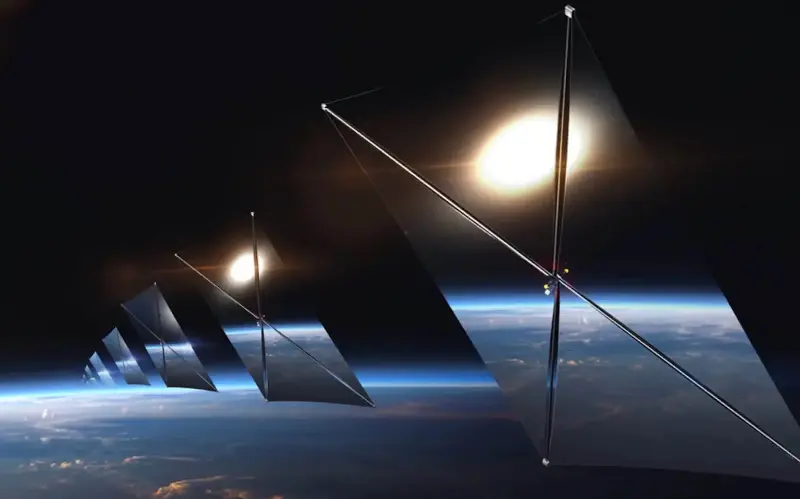
Deploying mirrors in space to create on-demand daylight could affect humans’ sleep, researchers say.
Officials in the US are considering plans by Reflect Orbital, an aerospace start-up, to illuminate parts of the Earth at night using reflective satellites, as well as from Elon Musk’s SpaceX to put up to one million more satellites in Earth’s low orbit.
However, the presidents of four international scientific groups, representing about 2,500 researchers from more than 30 countries, are among those to write to the US government with concerns.
The letter, written by the presidents of the European Biological Rhythms Society (EBRS), the Society for Research on Biological Rhythms, the Japanese Society for Chronobiology and the Canadian Society for Chronobiology, said: “The proposed scale of orbital deployment would represent a significant alteration of the natural night-time light environment at a planetary scale.”
The experts warned the Federal Communications Commission (FCC), which regulates satellites and space policy, that altering the natural rhythm of light and dark could have untold consequences on biological clocks that regulate sleep, and hormone secretion in humans and animals.
They also warned that it could impact migration of nocturnal species, seasonal cycles in plants and the rhythms of marine phytoplankton that underpin ocean food webs.
They urged the FCC and other regulators to conduct a full environmental review and set limits on satellite reflectivity and cumulative night sky brightness.
Prof Charalambos Kyriacou, a geneticist at the University of Leicester and president of the EBRS, told The Guardian: “We’re saying, please think before you go through with this, because this could have global implications for things like food security. Plants need the night. You can’t just get rid of it.”
The proposals by Reflect Orbital involve using satellites equipped with large mirrors to redirect sunlight back on to Earth “on demand”.
The idea would be to light up an area of five to six kilometres to boost solar energy production, provide lighting for construction projects, disaster responses and agriculture, the company says. The brightness would be adjustable “from full moon to full noon”.
Ruskin Hartley, the head of DarkSky International, a non-profit focused on protecting natural night skies, which has also written to the FCC, told The Guardian: “While ideas like mirrors on satellites beaming ‘sunlight on demand’ to Earth or mega-constellations of up to one million satellites for AI data centres may sound like science fiction, these proposals are very real.”
He added: “Scientific studies have already shown that the existing number of satellites in orbit has increased diffuse night sky brightness, or sky glow, by roughly 10 per cent.”
Experts say the number of satellites and debris in the atmosphere are to blame, and that it will only get worse if current satellite launch rates continue.
SpaceX wants to launch up to 1 million satellites to create a solar-powered computing network designed to run artificial intelligence workloads.
Mr Hartley said it could lead to a night sky where satellites outnumbered visible stars.
He also warned that plans to introduce mirrors risked the “possibility of intense glare or blinding flashes, particularly if systems malfunction or drift off target”.
A separate letter from the presidents of the World Sleep Society, European Sleep Research Society, Sleep Health Foundation, Australian Sleep Association and Australasian Chronobiology Society said that circadian disruption “is not mere inconvenience; it is a physiological mechanism driving major adverse health consequences”.
“We do not argue against space innovation,” the letter said. “The alternation of light and dark is not a trivial background condition. It is one of the oldest organising principles of life on Earth.”