



Down a fragrant tree-lined street in north London is the home of Auto Vivendi, an elite private members’ club with a library of supercars worth £8m for its subscribers to borrow. Through a discreet black garage door, the scent of magnolia and cherry blossom quickly gives way to the smell of cars.
Throaty. Heady. Rich. Which is what you have to be to pay the annual £15,000 subscription (plus a joining fee of £2,950). But for that price, members can drive whatever they fancy from a stable of thoroughbreds – some of which are lined up in front of me – that includes Lamborghinis, Aston Martins, a McLaren 750S Spider, a Porsche 992.2 GT3 and seven Ferraris.
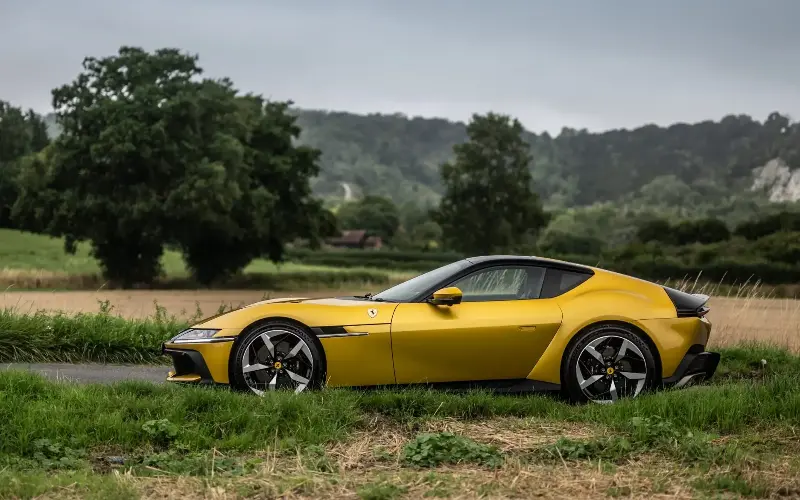
The Ferraris are the most popular, managing director Craig Williams tells me, as he opens up the bonnet of the 2024 yellow (giallo) Monte Carlo Ferrari 12 Cilindri, in which he is about to take me for a drive. He stares lovingly at its charismatic V12 engine, the type for which Ferrari is famed. Set far back into the chassis with its twin-headed red valve covers (they have become a staple, and gave the older Testa Rossa its name), this is the latest in a long line of exquisitely crafted 12-cylinder engines stretching back to 1947, when the first Ferrari road car was produced.
These internal combustion engines, along with the gated H-pattern gear shifter and round tail lights, are as much a part of Ferrari’s identity and appeal as the famous Prancing Horse of its logo.
So when founder Enzo Ferrari uttered the words, “I don’t sell cars, I sell engines. The cars I throw in for free since something has to hold the engines in,” he could not have anticipated the Ferrari Luce, the brand’s first all-electric vehicle, which is being launched next week: a four-door saloon with four electric motors and a colossal 122kWh battery.
But is a Ferrari without the engine still a Ferrari? That is the question.
The interior of the Luce has been designed by LoveFrom, the creative partnership founded by Sir Jony Ive and Marc Newson, known for stylish products such as the Apple Watch. Gone are the touchscreens bemoaned by drivers the world over. Instead, the Luce will have switches, dials and buttons, no doubt designed to recapture some of the tactile pleasure of the more analogue motoring experience on which Ferrari has built its $60bn valuation.
That it’s called the Luce, which means “light” in Italian, is ironic, says Williams, because this car will be anything but. Some early reports have suggested it could end up weighing as much as 2,300kg (nearly 2½ tons) – about as much as a Range Rover Sport, and more than twice the weight of a Ferrari F40, the company’s 1980s poster child.
It will, however, be extremely quick – at least in a straight line. The four-wheel drive, instant torque and 1,000 horsepower courtesy of those electric motors will make it accelerate as quickly as anything else to come out of the gates at Ferrari’s HQ.
But that sort of performance has come to be expected from electric cars these days, and what’s arguably more important is the character Ferrari can imbue the Luce with. How it can do this without the sound of an engine screaming away behind or in front of the cockpit remains to be seen. Ferrari is being guarded about what exactly the Luce will sound like. Interviews with designers have hinted at a sound “inspired by the electric guitar” that is to be generated by cleverly amplifying the frequencies emitted by the powertrain.
Will this be enough to excite the Ferraristas, as their most ardent collectors are known? Will customers want the car without the engine? “Our clients don’t really want electric cars,” says James Mills, of Racing Green, a carbon-balanced car storage facility in Kent, which houses classic and collector cars. “It will be fascinating to see if Ferrari can really convince them that a purely electric Ferrari is desirable. They want to spoil themselves, and actually, a great big V8 engine or a V12 with a Ferrari badge on it is part of the buzz.
“It doesn’t matter how accomplished the electric car might be; you haven’t got the thrill of that big, gas-guzzling engine making a tremendous noise and turning heads,” says Mills. “I used to work on Top Gear, and James May always said that a great car gave him the fizz in his nether regions, and that’s what Ferrari has always been about – whether you’re a man or a woman, you get behind the wheel and think, ‘God this is exciting.’ Can that happen with an electric car?”
Williams, too, is sceptical. Auto Vivendi’s contemporary Ferraris include a Purosangue and two hybrids – the SF90 and the 296 GTS – and the new Testarossa 849 is coming soon. Will he be procuring a Luce?
“I’m not sure, is the honest answer. I want to see it first. My reservations are that it’s going to be a significant price point, around £500,000 is what I’ve heard. We’re certainly not anti-electric – but with that price in mind, I have to question whether it will get used. Many of our members have electric cars already, so they want to try something different. We had a Rolls-Royce Spectre, also electric, which was a £400,000 car, and it did get used… but not that often.
“I don’t think the Luce will be a collector’s car, except for those who just want to buy every single Ferrari ever made. It’s a bold move by Ferrari, and I’ve no doubt it will be an incredible car to drive, so I will watch with interest what happens.”
Ferrari is one of the biggest brands – in any industry – in the world today, and its prancing horse one of the most recognisable logos. Founded by former racing driver and entrepreneur Enzo Ferrari in 1948 – and later reinvigorated by Luca Di Montezemolo – Ferrari sells dreams. They are the ultimate cars to aspire to, based on their legacy, reputation, sheer mystique and history in Formula One. Ferrari was one of the founding teams when the F1 World Championship series was inaugurated in 1950, and is the only team to have continuously participated until today.
Enzo was a marketing genius – he knew how to build cars, but he also knew how to create desire. And people will pay for that level of beauty and prestige. In 2018, the record for the world’s most expensive Ferrari was set when a 1963 250 GTO was sold to David MacNeil, the billionaire founder of WeatherTech, for $70m.
Ferrari is based in Maranello, the town in northern Italy to where Enzo moved his operation in 1943 to escape wartime bombing. There is a limited production run and there are waiting lists for every model. Ferrari just doesn’t produce that many cars, which keeps them desirable (treat ’em mean, keep ’em keen, as my grandmother used to say). It currently produces around 14,000 cars per year, which, according to the business podcast Acquired, is the same as the number of Toyotas sold every 10 hours. Porsche, by contrast, makes 22 times that amount.
They are known for their sheer quality and longevity – incredibly, 90 per cent of Ferraris ever produced are still on the road today. These cars are registered and roadworthy, rather than driven daily, and probably well maintained, but it is testament to the fact that the parts can be replaced – as Ferrari still manufactures the components for its classic models – and that they are very well built in the first place.
“It’s very much been about the engines,” says Tom Hartley Jr, whose exotic-car company is based in the Cotswolds. “The engines were so well built that even if you take a car that’s 60 years old [it won’t need modifying]. Unlike, say, an Aston Martin, which you can do many modifications on to improve the driving of the car compared to what it was like in 1960. Ferraris were so well engineered that you don’t need to. It’s in their pedigree, and it’s hard to improve on what they built 65 years ago.
“That they’re bringing out a new model that doesn’t even have an engine is, for me, quite sad. It’s not part of their DNA, it’s not something you would associate with Ferrari and it goes against everything the business was founded upon.”
Hartley sold his first car at the age of 11 and became a millionaire at 14. These days he specialises in collectable cars, ranging from vintage to classic, including the most modern supercars and hypercars, and significant F1 cars. His company sold $700-800m-worth (£525-600m) of cars last year, he says.
Ferraris are the most popular. “There’s the collector car market and then there’s the Ferrari market. It’s the pedigree, the fact that it’s still active and present today, the history of the brand – it’s so evocative compared with some other manufacturers, and there are so many Ferrari collectors and aspiring collectors all over the world.”
Ferraris don’t devalue. This is a major factor with EVs, in Hartley’s opinion. “Something that’s really killing electric cars is the second-hand resale value. It’s so poor. Take the Porsche Taycan – terrible. People are losing way more money than they would selling a normal internal-combustion car.”
Does he think people have got EV fatigue? “If you’d asked me five years ago, I probably would have accepted that all cars would be going electric – and I don’t think that’s the case anymore.” (Jeremy Clarkson has famously dismissed electric cars, labelling them “white goods”, although even he gave a rave review to the Renault 5 E-Tech.)
Those who remain unconvinced might recall that, in February of this year, Lamborghini cancelled the launch of its supercar, the Lanzador EV, having invested two and a half years and millions of dollars in its creation. Chief executive Stephan Winkelmann said that Lamborghini’s target market had “close to zero” interest in electric vehicles. However, the company has seen record sales with hybrids, and it is thought that it will reposition the Lanzador as a hybrid in 2029.
How do financial investors view this moment? When Lamborghini cancelled the Lanzador, City analysts immediately inferred that the Luce could also be a risk, but according to a report from Bloomberg, “Ferrari remains the anchor for ultra-luxury auto valuations”. For them, Ferrari (which is listed in New York and Milan) remains the benchmark for luxury cars, more comparable to a fashion brand like Hermès than other automotive companies. Its core business is extremely strong and it doesn’t need the Luce to succeed, but nonetheless, for an enterprise as elite as Ferrari, an EV is “a swing factor”, which could affect investor confidence. Key concerns for investors, say experts, are exclusivity and pricing.
To an extent, the same goes for supercar collectors. This is a class of buyer who is unlikely to care about eco-credentials. The largest private car collection in the world belongs to the Sultan of Brunei, Hassanal Bolkiah, who has amassed roughly 7,000 cars worth more than $5bn, including 450 Ferraris. Jay Kay, AKA musical artist Jamiroquai, is an avid Ferrari collector, as are Pink Floyd’s Nick Mason and broadcaster Chris Evans.
Shipping investor Iain Urquhart, 45, from south-east London, is a more modest collector. “I was always a Porsche guy,” he says. “I have six, but I bought my first Ferrari 18 months ago, a 458 Spider, and I followed it up this year with an F12 Berlinetta. They’re something special, definitely. You just don’t see them on the road that often, they’re absolutely stunningly beautiful, and the engine is just… different. My Ferraris just seem to know how you want to drive them, and even if you just want to pootle around town for a bit you can – the car is like a little pussycat. It’s intuitive.
“If the question is, can it be a Ferrari with an electric motor? I doubt it – it’s hard to imagine. But then Ferrari have always seen themselves as disruptors, so let’s see. I still like the visceral, mechanical, naturally aspirated noise – but perhaps that’s because I was born in 1980. Maybe my children will see the Luce as a pinnacle, and it will be sought after. I can’t imagine it, but it could happen.
“I know a guy who has 50 cars in his collection, and he said one of his favourites – which really surprised me – is the Purosangue. So perhaps the Luce can tap into that market.”
Initially, the Purosangue – the company’s first ever four-door, four-seater car, launched in 2022 – was also considered a bit of a faux pas by Ferrari purists. The idea of Ferrari producing what was technically an SUV was anathema to some, but it was handled well. First, the firm refused to call it an SUV, referring to it instead as an FUV (“Ferrari utility vehicle”). And reviewers loved the Purosangue, saying it still felt like a Ferrari. “The most fun SUV ever,” said automotive news site Motor1.com – “handles like a sports sedan, looks like a Ferrari.” It sold out the first year’s production and now has a waiting list. Ferrari temporarily closed orders shortly after launch because demand was so high.
In its favour, one unusual thing about the Luce is that all the component parts will be made at the Maranello factory, with Ferrari-owned technology. The battery is modular, made up of four or five sections, so each section can be replaced if something goes wrong, rather than the whole battery having to be thrown into landfill. And the Luce will run for 330 miles on one charge.
So what would Enzo think? Despite his allegiance to engines, he was also renowned for being able to turn the page and move forward, and was a keen adopter of new technology. “The best Ferrari ever made is the next one,” he once said.
“In the end, Ferrari was not a sentimental man really, and he would have seen it as a necessary project,” says Richard Williams, the author of Enzo Ferrari: A Life. “I think it’s interesting that the EV is a four-door saloon car, and at that level of the market there is a cachet to having an electric car. Whatever it is, it will be quick, there’s no doubt about that, but it won’t make a noise. When you see something like a Porsche Taycan tooling around the streets of London in absolute silence, it is rather cool. That’s when I began to see the point of electric cars, apart from the ecological aspect.” (Not everyone would agree with that. The sound does have a function, as it increases with the throttle input, which makes you aware of the speed you’re travelling at.)
One unadulterated enthusiast is Jodie Kidd – the former model, racing driver, host of the YouTube channel Kidd in a Sweet Shop and general petrolhead – who saved up to buy a steel-grey Ferrari 550 in her mid-20s. She felt she had arrived. “It was a real moment in time – you work really hard and then you buy a Ferrari; I felt very lucky and blessed to have got to that point. It was a stunning car, and I put a big sound system in it and loved it dearly.”
After a few years, her father said: “Jodie, you’ve got a baby now and you have to retire the Ferrari.” So she sold it. “And about five years later, some random person at Goodwood came up to me and said, ‘I’ve got your Ferrari.’ I didn’t know whether to love him or hate him.”
So what does she think about the Luce? “Well it’s still a Ferrari, and Enzo was always thinking about the future. And I think that getting Jony Ive and Marc Newson on board is brilliant. It’s interesting, because they are known for industrial design but they are massive car fanatics.
“But [electric technology] is somewhere that every car manufacturer has to go eventually. And the infrastructure is catching up – we now have almost double the amount of charging points in the UK as petrol points. But it’s going to have lovers and it’s going to have haters.”
As for my ride in the 12 Cilindri, although bound by London’s cruel speed limits, it is still possible to get a sense of the classic Ferrari formula that has captivated enthusiasts for so long: I switch into car-nerd mode, and the engine is the centre of attention. Long nose. Comfortable bucket seat. Carbon-fibre door panels. F1-style steering wheel. Panoramic glass roof. Downshifts with the flappy paddles for rapid gear changes elicit a pleasing blip of the throttle, and on the few occasions when Craig Williams feels able to put his foot down, the acceleration is smooth and the exhaust note is worthy of every simile Clarkson et al have come up with.
We glide around north London, managing to avoid hitting the cluster of tourists on the famed zebra crossing on Abbey Road. It feels a bit of a waste at that speed, but Williams tells me about Auto Vivendi’s annual 200mph challenge, where, with a bit of guidance, members can take the cars out on a military runway and really put their foot down.
“This one will be going soon,” he says cheerfully of the Cilindri, “to be replaced by the Spider – the convertible version.” He revs the engine so I can fully appreciate the bass tones of the V12. “Sorry you haven’t had much of a thrill here, but hopefully you’ve got a little flavour,” he adds.
“I married the 12-cylinder engine and I never divorced it,” Enzo Ferrari once said. Whether that union is unbreakable remains to be seen.
Read motoring editor Paul Hudson’s verdict on the new Ferrari Luce next Monday, following its unveiling in Rome