



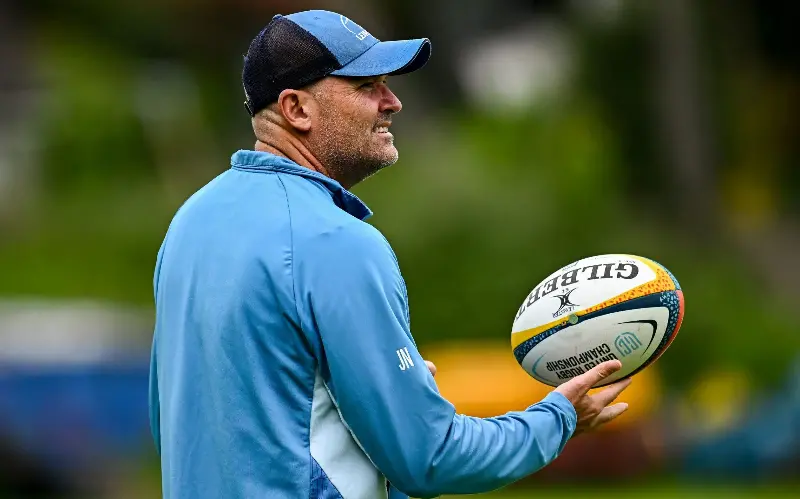
The curious case of Jacques Nienaber’s reign at Leinster is about to come to a conclusion. By late on Saturday afternoon, in what are forecast to be sweltering conditions for the Irish province’s Champions Cup final against hotly fancied Bordeaux-Bègles, the jury is likely to deliver its verdict.
In professional sport, the finest of margins often determine such judgments, and in Nienaber’s case, this feels particularly pertinent when assessing the South African’s influence and impact at Leinster.
The man who helped guide the Springboks to successive World Cups in 2019 and 2023 was hired by Leinster for moments just like those they will face in Bilbao. The 53-year-old was seen as the final piece in the jigsaw to end Leinster’s increasingly desperate pursuit of a fifth Champions Cup title.
But his tenure, since his arrival in November 2023, has so far not been transformative, and not without controversy.
When he first took over, there was genuine excitement among the players to learn from him, having been on the other side of the fence on the international stage, and gain insight into his winning formula.
But since then, his critics point out that during his time as senior coach, Leinster have lost the attacking fluidity that characterised their run of four Champions Cup titles between 2009 and 2018, by focusing on the blitz defence executed so brilliantly by the Springboks.
Those who are concerned that he might return to the Springboks next year, armed with inside knowledge of Ireland’s leading players before the World Cup would have been alarmed when he was interviewed on South African television in the build-up to Ireland’s match against South Africa last November and said he missed his time with the Springboks.
Given that it was conducted at the Springboks’ hotel before they faced Andy Farrell’s side, it looked misjudged. He later said his comments had been taken out of context but attracted criticism in the Irish media.
The change in approach, with Leinster becoming much more focused on a pressure, kick and defence-orientated game, has also had a negative impact on Ireland, who attack and defend in a different way.
When Stuart Lancaster was senior coach at Leinster, there was a much smoother transition from the Leinster to Ireland camps, whereas the defensive mistakes evident in Ireland’s opening Six Nations defeat by France this year were a sign of that lack of overlap.
But the overriding reason that the jury has remained out so far on Nienaber is that the wait for a fifth Champions Cup has continued. The defeat by Northampton Saints in the semi-final last year undermined confidence in the whole project, given that it was their defence and kicking game that was exposed by the English side. Winning the United Rugby Championship last season was an achievement of substance but did not get much credit because of the fallout from the Saints defeat.
With Leinster failing to hit the heights of previous seasons this year – they lost three of their first four games in the URC and six in total, and go into this Champions Cup final for the first time in a decade as underdogs – another failure at the final hurdle will be seen as a defining moment to how his legacy at the province is viewed.
While Lancaster became a much-loved figure within Leinster supporters during his tenure as senior coach, there is a more indifferent feeling about Nienaber, which is at odds with his reputation.
Part of this relates to his relatively low profile. He is said to like a pint around Dublin, is engaging and interesting company, but given that Leo Cullen conducts the majority of the media interviews as director of rugby, Nienaber is far from a prominent figure in the Irish public. As someone who does not court the limelight, there is less of an attachment to him, except when things go wrong.
One seasoned observer said that while he was not widely disliked by supporters, he was not fondly promoted by many either.
And yet the twist in this tale is that while Leinster have made hard work of their domestic and European campaigns this season, they might arrive in Bilbao with a mix of menace and desperation that could get them over the line.
The players are so ingrained in his defensive strategy that it is less of an issue to slip back to the Leinster approach after the Six Nations, and whereas they were outmuscled in their back-to-back defeats by La Rochelle in 2022 and 2023 finals, Nienaber’s side are ferociously physical – both in defence and their counter-rucking.
While Leinster once relied on their complex attacking shapes and ball retention to dominate Europe, their hopes of winning the title this year rest on stopping the attacking genius of a Bordeaux-Bègles side laced with game-breaking talent such as Louis Bielle-Biarrey, Damian Penaud and Matthieu Jalibert. In the last month, Leinster’s attack has also found greater rhythm.
The reasons behind their stuttering season are complex, including re-integrating so many players from the British and Irish Lions tour, but Leinster could yet finish the season as European and URC champions, an achievement that would erase any doubts about Nienaber’s impact. Another defeat, and, well, the jury is unlikely to be forgiving, however fair that might be.