



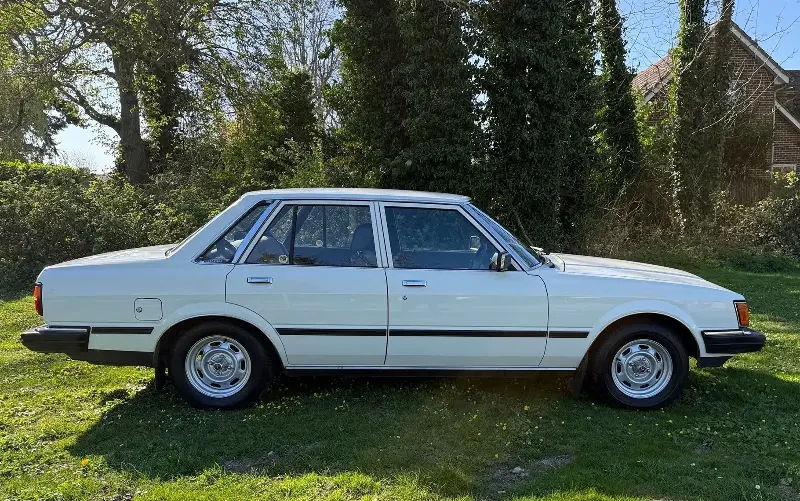
Some cars are taken for granted during their lifetime. Toyota never intended the Cressida to cause a stir in any way. Its purpose was to convey the driver to their next business meeting, or their passengers to Heathrow, comfortably and without drama.
In the past 40 years, its numbers have diminished to the point that this 1982 DX is believed to be the only one still on the road.
The model history of many Japanese cars is fairly complex and the Cressida is no exception. It began in 1968 as the Corona Mk2, to bridge the gap between the Corona and the larger Crown. Toyota launched the third-generation version in 1976 and the following year began UK imports using the Cressida name.
Of the vast line-up offered in Japan, Toyota GB offered only the petrol-engined GL and DX Estate, along with the DX diesel saloon, with a 60bhp, 2,188cc unit from the Hi-Lux commercial vehicle.
The 1975 voluntary agreement restricting Japanese imports meant concessionaires were keen to attract buyers of larger cars, which could be sold at greater profit. While the Cressida was more compact than the Crown, it could still compete in the upper Ford Cortina/lower Ford Granada market sector.
The Telegraph thought the DX was “a competent rather than a memorable car from the driver’s point of view”. However, competence was a quality much valued by Toyota owners, many of whom had strong memories of the utter incompetence of recent British models.
This newspaper found that the Cressida diesel “pulled easily and fairly quietly”, although with a top speed of just more than 93mph, with 0-60mph in 19 seconds, it was unlikely to win the battle of the traffic lights.
Toyota GB aimed the DX at taxi and private hire firms as well as managerial buyers who wanted to take advantage of its “unrivalled economy in the 2.0-litre class”.
Previous diesel “executive cars” were unusual: in early 1981, the UK and Switzerland were the only countries in Europe in which diesel fuel was more expensive than petrol.
Car owners were unable to take advantage of the bulk discounts available to haulage firms and garages with a solitary diesel pump tended to charge 10 to 15p more than for a gallon of four-star petrol.
However, a 20p cut in duty which came into effect in the summer of 1981 meant diesel could now be 12 to 15p cheaper per gallon. Toyota promised that the Cressida DX offered “Dream car quality with an economy at an everyday price”.
By 1982, it cost £6,518, making the Cressida much cheaper than the Ford Granada Mk2 2.1 Diesel at £7,315, the Opel Rekord 2.3D at £7,950 or the Peugeot 505 GR Diesel at £7,879.
As for the Cressida’s Japanese rivals, neither the Datsun Laurel nor the Mazda 929 was available with diesel engines in the UK. British Leyland offered the Rover 2400 SD Turbo, but that cost £10,500 and was a five-door fastback chiefly for the Italian export market.
Ambitious Toyota dealers could also appeal to a buyer’s inner social climber by pointing out that the Cressida was nearly £5,000 cheaper than a Mercedes-Benz W123 300D.
Nor did the DX lack creature comforts. In 1982, a driver’s seat adjustable for height and lumbar support, an LW/MW/FM radio with an electric aerial and a remote control for the driver’s door mirror and fuel flap were notable sales features.
All Cressidas had a five-speed gearbox, while the DX had power-assisted recirculating-ball steering instead of the petrol versions’ rack and pinion set-up. One absent item was a rev counter, but there was little need for one.
UK sales of the Cressida ended in 1983, a year before production ceased. In the previous six years, Toyota GB had imported 15,269 units, yet this example is one of only 15 surviving Cressidas of any type.
This DX is a fascinating reminder of when grey was the “in” colour for Toyota interiors, not to mention how your neighbours would be amazed at its “door open” warning lights.
Toyota may have said “Pleasure Comes Alive Driving Cressida”, but the reality was “You will arrive at your meeting without having to desperately search for an AA or RAC telephone box”.
And there are far worse ways for a car to be remembered.
We use the fascinating www.howmanyleft.co.uk for figures of surviving examples but some cars present more of a challenge than others, so the figures are rarely authoritative. Some pre-1974 records were lost before the DVLA centralised the process, while some cars have their model type misnamed on the V5 registration documents. A further issue is the omission of the exact model name or generation, or distinction between saloon and estate body styles.