



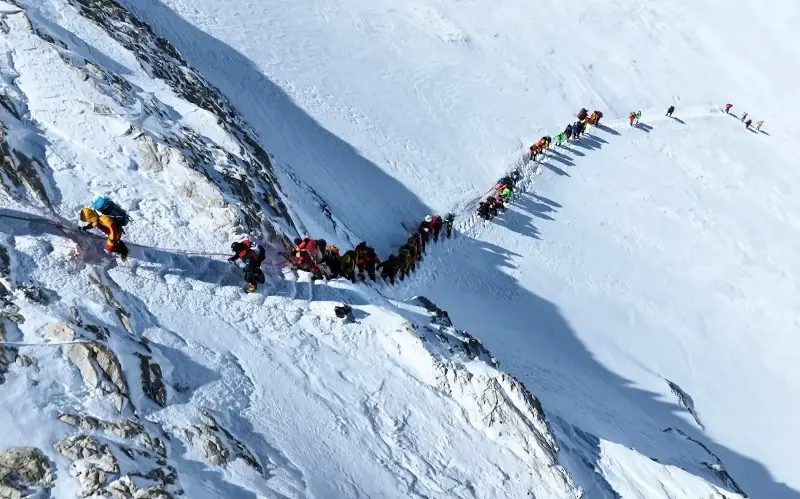
Mount Everest is becoming clogged with climbers trying to reach the summit, with record queues forming across the snowy flanks of the world’s highest peak.
Drone footage shows hundreds of climbers heading from a tented encampment towards the 29,032ft (8,849 metre) summit in single file.
The ant-like queues have been forming between Camp Three and Camp Four, a perilous part of the climb that is described as the Death Zone, where mountaineers require supplementary oxygen because of the high altitude.
The traffic jam of climbers has been caused in part by Nepal deciding to issue a record 492 permits this season.
Given that most mountaineers attempt the ascent of Everest with the help of at least one Sherpa, that means more than 1,000 climbers are expected to head for the summit in the next few days.
Officials said 274 climbers reached the top of Everest on Wednesday, setting a new record for the highest number of successful ascents in one day.
The mountaineers took advantage of a window of clear weather, according to the Expedition Operators Association of Nepal.
The large numbers have rekindled concerns about the over-commercialisation of climbing Everest.
“The main reason for the queues is simply that there are more people climbing the mountain,” said Tim Mosedale, a British expedition leader who has reached the summit of Everest seven times.
Climbing the world’s highest mountain is ever more popular – and is drawing people with minimal fitness and experience who are motivated by showing off their achievements on social media.
“There are more and more people with a drone and an Instagram account who are looking for content,” Mr Mosedale, who has 25 years of experience climbing in Nepal, told The Telegraph.
“If you have unfit or incompetent people on the mountain, then they are putting the lives of Sherpas at risk. There are a lot of people who are out of their depth, who don’t realise how close to the edge of safety they are.”
Wealthy climbers are demanding more oxygen during the ascent, which means they need two or even three Sherpas to carry the oxygen bottles – further increasing the number of people on the mountain.
An ascent of Everest with extra oxygen supplies costs around $65,000-$90,000 (£52,000 to £72,000) per person.
The bottleneck of recent days is also down to a 100ft-high serac, or ice block, which temporarily shut the route to the top and shortened the climbing season.
Nepalese mountaineers known as “icefall doctors” eventually managed to use ropes and ladders to make a route past the large mass of ice that had blocked climbers from moving past Base Camp for two weeks.
“A major obstruction – a large unstable ice serac in the Khumbu Icefall – has been safely addressed following detailed assessment and adherence to safety protocols,” the Nepalese department of tourism announced at the end of April.
“As climbers navigate the route, utmost caution is urged, particularly in the serac-affected section. Wishing all a safe ascent.”
The climbing season on Everest is short, running from late April until the end of May.
The large number of permits granted to climbers this year will generate more than £4.5m in government revenue, according to the department of tourism.
So far this year, at least three guides or climbers have lost their lives on Everest, including a 20-year-old Sherpa who fell into a crevasse near Camp Three.
Other towering peaks in Nepal have also claimed lives. Earlier this month, Johannesen Shelley, a 53-year-old American climber, died on Mount Makalu, which at 27,838ft is the world’s fifth-highest.
She had reached the summit and was descending the mountain when she was struck by an avalanche, which also injured one of her Sherpas.