



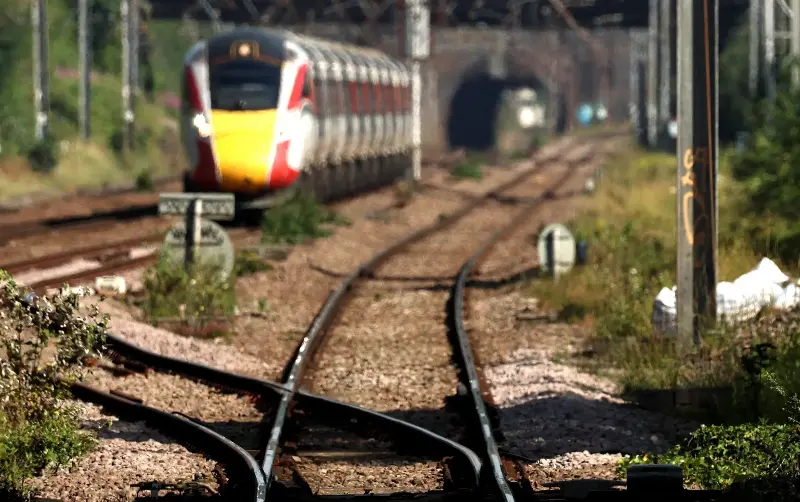
If your rail journey was disrupted during this week’s heatwave, you may have been the victim of “sun kink”.
The dangerous phenomenon occurs when steel rail tracks expand and buckle in extreme heat, sometimes warping violently into S-shaped curves in a matter of seconds.
Sun kinks typically become a severe risk when air temperatures reach 30C (85F to 90F) and above, with the steel getting significantly hotter as it bakes in the sun.
Thermal expansion forces the steel to lengthen, but because the tracks are fixed, there is nowhere for it to go, so it must bend sideways or upwards.
Ripples in the line can cause trains to derail, which is why so many services have been cancelled or run with speed restrictions this week, bringing travel chaos to commuters already dealing with sweltering temperatures.
The expansion of the rails can also cause “switch-creep”, which brings a misalignment of switch blades and stops trains from being routed through the points safely.
Xueyu Geng, professor in geotechnical engineering at the University of Warwick, said: “Steel rail expands significantly in extreme heat: a 1C rise in temperature causes roughly 11mm of expansion per kilometre of track.
“Rail is installed with a ‘stress-free’ temperature in mind, and when ambient and solar-radiation temperatures exceed that threshold, the track can buckle laterally, what the industry calls a sun kink.
“This is why speed restrictions are imposed on the network during heatwaves; it is not a precaution, it is a structural necessity.”
The problem is worse now than in the past for two main reasons. The climate is getting hotter, with far more days reaching 30C and above, but also because Britain’s tracks no longer allow for significant expansion.
In the past, there were regular gaps in the track, which gave room for dilation on a hot day, not to mention providing the traditional clickety-clack noise of trains.
Between the 1930s and 1950s, however, lengths of track were welded together – known as continuous welded rail (CWR) – to make the ride smoother, reduce structural wear, and allow trains to travel at higher speeds.
It made them more vulnerable to heat expansion and increased the risk of buckling.
Yet many countries switched to CWR and still do not suffer the same problems as Britain in the heat. So why does the UK do so badly?
The answer lies in the “stress-free temperature” (SFT) of rail tracks, which is the temperature that rails can reach without buckling.
In hot territories – such as Australia, India, Africa and the southern US – the SFT is set between 35 and 40C. In Britain, it is just 27C. But this is because it also has to cope with extremely cold temperatures in winter.
If the track is designed solely for excessively hot temperatures, the extreme contraction in freezing winter weather would cause dangerously high tension, which can snap the rail or make it shear off its anchorage.
So the SFT has to be a compromise between keeping the rail from buckling in the summer and breaking in the winter.
Soaring temperatures can also cause signals, power supplies and track-side telecoms to overheat, while power lines can sag and catch on pantographs (the apparatus mounted on roofs of electric trains), halting train movements or forcing lengthy reroutes.
Paint them white?
Train companies are being forced to develop new solutions to tackle the growing problem of heat.
John Lawrence, chairman of the IET Railway Technical Network, said: “One of the simplest ways we tackle overheating tracks is by painting them white, which can lower track temperature by 5C and cut the signalling failures that cause major disruption.
“It’s a technique used elsewhere too, in countries more used to high temperatures – in Italy, for instance, engineers often paint the inside faces of rails white to reflect sunlight and reduce the risk of buckling.”
There is one more problem that severe heat is creating: catastrophic changes to earthwork embankments holding up the railways.
Usually, grassy embankments benefit from a phenomenon called unsaturated soil suction in which clumps of moist earth create an inward pulling action, squeezing the particles together and shoring up the bank.
But prolonged extreme heat disrupts the suction effect, making embankments less stable, while also killing off vegetation and the roots which bind the soil together.
Cracks can form in hard, dry ground, which can let running water in and disrupt the stability further, triggering landslips that can leave tracks suspended in mid-air.
Prof Sukumār Natarājan, director of the Centre for Regenerative Design & Engineering at the University of Bath, said: “We need to learn from locations in the world that frequently experience similar conditions on how to better design our rail infrastructure.
“The frequency and severity of heatwaves is simply going to be increasing and infrastructure designed for 20th-century conditions will not be reliable in the 2080s, when the worst effects of climate change will be visible.”