



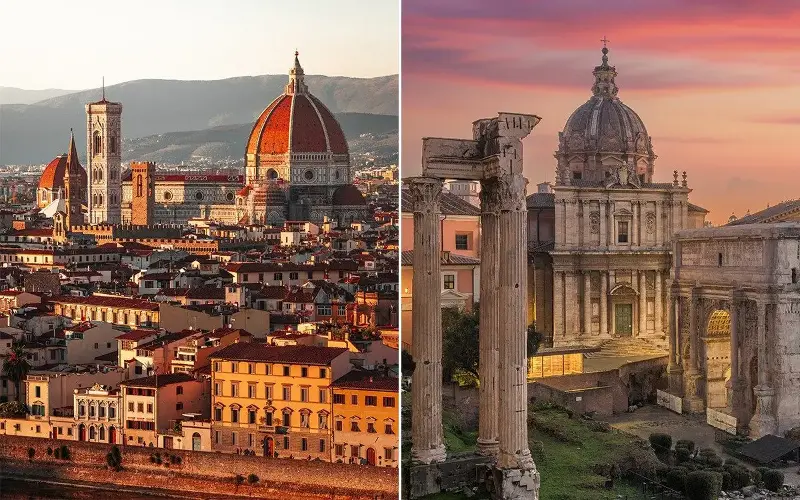
Rome has been a tourist destination for visitors to Italy pretty much since its foundation. The cave where the city’s mythical founders, Romulus and Remus, were supposedly suckled by a she-wolf was already being touted as a visitor attraction under Julius Caesar.
It wasn’t until the advent of that 18th-century rite of passage known as the Grand Tour – and the Romantic cult of the Tuscan Renaissance – that proudly mercantile, cultured Florence began to challenge its imperial, ecclesiastical, pleasure-loving southern neighbour. Today, both Italian cities are rightly among the world’s most popular short-break destinations. But does one have an edge over the other?
Florence is smaller, with most of the main sights clustered within a 15-minute walk of one another in the historic centre, so it scores on ease of access. But at peak times, the pressure exerted by the city’s 15 million annual visitors is amplified by this “square-mile” effect.
Rome, on the other hand, spreads out across a galaxy of urban villages, as do its museums, galleries, parks and churches. So, despite hitting a record 23 million visitors in the Jubilee Year of 2025, it can be easier to find a quiet corner here for a cappuccino or glass of frascati. Both make for great late-autumn and winter destinations, when daily visitor numbers drop to a third of their Easter and summer peaks. And if you feel you backed the wrong cavallo, take heart, jump on a high-speed train, and you can be in the other place in less than 90 minutes.
So, which makes for the better three or four-day jaunt – Rome, the Eternal City, or Florence, Cradle of the Renaissance? The jury will now retire.
Food and drink
Winner: Florence
Elizabeth Minchilli runs small-group food tour company Via Rosa with her two daughters, and knows both the Florentine and Roman food scenes inside out. Though she’s lived in Rome for decades, it’s the Tuscan city which she recommends for anyone on a short break who is keen to eat and drink like a local. “Food is culture,” she says, “and Florentine culinary culture is easier to ‘get’ in a few days than Rome’s, which can be difficult to break into.”
In Florence, Minchilli recommends seeking out long-standing neighbourhood restaurants rather than fancy gourmet places. For classics such as ribollita (a filling, vitamin-packed bread and vegetable soup) or the city’s famous bistecca fiorentina T-bone steak, she recommends the ever-reliable All’Antico Ristoro di Cambi, Alla Vecchia Bettola, Trattoria Sostanza, Cammillo or Buca Lapi.
“These are all basically local trattorias with high standards,” she says, “specialising in simple, seasonal food.” She recommends booking well ahead however, as “somewhere like Cammillo is more difficult to get into than a hot Michelin-starred joint”.
Florence is also great for street food, Minchilli points out, with its most authentic at lampredotto stands, such as Sergio Pollini or Nencioni (once you’ve eaten boiled tripe inside a bread roll, you basically become an honorary citizen).
Where Rome does hold its own against Florence, Minchilli believes, are its local produce markets – especially Testaccio market, which offers the triple whammy of “shopping for a hotel-room picnic, shopping for food specialities to take home, and eating right there at street-food booths like Casa Manco or Mordi e Vai”.
Minchilli’s daughter Sophie advises adventurous visitors to Rome to make the effort to head towards un-touristy outer districts such as Garbatella – “grab a slice of pizza at Pantera and wander the streets of this distinctive garden suburb” – or San Lorenzo, which has “a strong local character and excellent food scene… I love eating at Mazzo and Tram Tram”.
Museums and galleries
Winner: Florence
This score has more to do with the effort required to see all the major draws in a long weekend than the wealth of what is on offer. In Rome, even the glories of the ancient world are spread across at least four venues: Palazzo Massimo, Palazzo Altemps, the Musei Capitolini and the Vatican Museums.
Mopping up some of the city’s great Raphaels, Caravaggios and Berninis requires at the very least a visit to the widely spread-out museums of Palazzo Barberini, Galleria Borghese and (once again) the Vatican Museums.
Florence, on the other hand, has what is virtually a one-stop art fix in the sprawling Uffizi Galleries with their bevy of Botticellis and other Renaissance chart-toppers, and it also offers the bonus of one of Italy’s most dynamic temporary exhibition venues, centrally placed Palazzo Strozzi, which, in recent years, has showcased artists from Donatello and Fra Angelico to Jeff Koons and Mark Rothko.
Shopping
Winner: Florence
In Rome, the luxury brand boutiques and upscale department stores spread out between the foot of the Spanish Steps and Via Condotti, while in Florence, they colonise Via Tornabuoni and the nearby Piazza della Repubblica area. No winner here: both are central and blandly global.
In among the big names, you’ll find some more quirky home-grown options, which often cluster in smaller streets: in Rome, Via dell’Oca and Via della Penna near Piazza del Popolo, and in Florence, the cute backstreet of Via delle Belle Donne (“Beautiful Women Road”) are good hunting grounds for indie fashion and jewellery. So far, that’s a 2-2 draw.
But Florence pulls ahead on one front: artisanship. The city’s small craft workshops may not be as widespread as they were in the Renaissance, but they’re still in better health than in just about any other major Italian city. Head to the Oltrarno district, south of the Arno river, for the best selection. Stop into bookbinding and paper marbling bottega Giulio Giannini e Figlio, now in its sixth generation, for special gifts, including personalised photo albums and notebooks.
In his Piazza Pitti workshop, milliner Antonio Gatto makes hats that range from soberly chic to extravagant, while the creations of jewellery maestro Alessandro Dari, on show in his witchy, Gothic showroom-museum in Via San Niccolò, take “extravagant” as a starting point. There are dozens of other worthwhile craft addresses here, ranging from leather and shoemaking through metalworking and glass-engraving to micro-mosaics and – at the wonderful Flora Lastraioli – hand-embroidered silk lingerie.
Tourist attractions
Winner: Rome
Leave out museums and galleries and the two Italian cities go down to the wire on glorious, art-filled churches. Whether you prefer Florence’s Duomo over St Peter’s is a matter of taste; both in their own ways are magnificent. The great Florentine basilicas of Santa Croce, Santa Maria Novella and San Lorenzo offer arguably more art thrills in one single building than any Roman equivalent, but the Eternal City has some wonderful smaller churches, including a few you can pop into just to see one painting. A personal favourite is Caravaggio’s moving Madonna dei Pellegrini in Sant’Agostino.
But Rome wreaks vengeance, like Maximus in Gladiator, when it comes to the ancient world. This was already a thriving, centuries-old metropolis in the first century BC when “Florentia” was founded as a military colony for the Empire’s army veterans. The signs of that high-water mark are everywhere, among them the Colosseum, the Roman Forum and Palatine, the Baths of Caracalla, and the Pantheon – a remarkable engineering feat that today looks more cleanly modern than many of Rome’s twiddly Baroque flourishes. Florence can summon a small, scenic archaeological area in its bucolic satellite town Fiesole, but it’s small change compared with Caput Mundi.
Sport
Winner: Rome
It depends whether you’re a doer or a watcher.
With its riverside trails and cycle tracks, Florence definitely edges it for urban running and cycling enthusiasts – though Rome does boast one of the world’s more atmospheric marathons, which sets off from the Colosseum.
That remarkable arena’s modern-day equivalent is the Stadio Olimpico, which rises above the Tiber north of the centre. Part of Mussolini’s bombastic Foro Italico sports complex, this three-in-one venue hosts AS Roma and SS Lazio Serie A matches as well as Six Nations rugby ties. Add the adjacent complex of tennis courts, home to the Italian Open – today eagerly followed by a country in the grip of Sinner-mania – to make it “advantage Rome”. But it’s a small one.
The vocal passion of the Fiorentina fans at Florence’s Stadio Artemio Franchi makes up for the not always brilliant performances of the 11 purple-clad men on the pitch, and, if things are going badly, you can always admire the stadium itself, an elegant example of Italian Rationalism designed in 1931 by great Italian architect-engineer Pier Luigi Nervi.
Florence can also offer what is perhaps the most brutal legal spectator sport outside Rollerball. Held in Piazza Santa Croce each June, Calcio Storico Fiorentino is a distant ancestor of rugby in which the ball is often invisible underneath heaps of brawling tattooed men.
Transport
Winner: Florence
Until 2019 this would have been difficult to call, as public transport in both cities was pretty dire. That year saw the debut of the sleek new T2 tramline from Florence’s Peretola airport to the city centre – journey time 20 minutes, ticket price €1.70 (£1.50). Another line, the T1, connects with the long-distance bus hub and mega car park of Villa Costanza on the motorway ring road. Also tipping the balance towards Florence is the ultra-central location of the city’s main Santa Maria Novella train station. Served by high-speed trains to Rome, Milan and Venice, it’s just a 10-minute walk from the Duomo and other key sights.
Rome’s metro system was inaugurated in 1955 and hasn’t progressed hugely since then – though to be fair, it’s not easy to dig here without archaeology getting in the way. The short extension of the third Metro C line from Colosseo to Piazza Venezia is pegged for completion in 2033, and, in the meantime, is creating all sorts of traffic chaos.
That leaves buses: fine if you have plenty of time, don’t mind being packed in like sardines and – on tourist routes such as the 64 from Termini station to the Vatican – keep a firm grip on your wallet. Taxi lobbies in both cities mean that waiting times can be long, prices high and street-hailing frustrating. Apps such as Uber are no solution: they simply default to the licensed taxi or NCC limousine networks.
Outdoor space
Winner: Rome
A combination of enlightened administrators, aristocrats fallen on hard times and lucky timing gave Rome the three large parks – Villa Ada, Villa Doria Pamphilij and Villa Borghese – that provide shade, recreation and picnic opportunities for locals and visitors within easy reach of the centro storico. The most central of the three, Villa Borghese, is dusty but delightful with its old-school pony rides, boating lake and eclectic Cinema dei Piccoli children’s cinema.
The Florentine equivalent is the Parco delle Cascine, the go-to open-air gym for local joggers and cyclists, which stretches along the banks of the Arno some way west of the centre. Yes, the formal Medici-era Boboli Gardens are far more central, but there’s a €10 (£8.60) entrance charge: they are more a landscape museum than the kind of place you can take a frisbee.
Built before much thought was given to public green space, the ancient hearts of both cities become furnaces in the height of summer, but Rome just pips it in the piazza play-offs thanks to a scattering of small, hidden neighbourhood squares. The one area where Florence really scores is in its easy access to beautiful Tuscan countryside: there are olive groves, vineyards and country villas within a 30-minute walking radius of Ponte Vecchio.
Safety
Winner: Rome
Petty theft involving visitors is often out of step with other crime markers (Mafia-ridden Naples, for example, is in fact one of Italy’s safer cities for tourists). But it may still come as a surprise to learn that, according to the Italian “Criminality Index” compiled annually by financial newspaper Il Sole 24 Ore, you are statistically more likely to get your pocket picked or your bag snatched in Florence than in any other Italian city – including Rome, which has been synonymous with criminal legerdemain since pilgrims first began to journey there in the Dark Ages.
The dangers can mostly be avoided by being extra careful on public transport and when sitting outside bars and restaurants. The two cities are as bad as each other for mobility-related personal safety: Florence has ridiculously narrow pavements (you think the Medicis walked anywhere?), while the Roman cobbles known as “sanpietrini” can be treacherously slippery when wet.
Hotels
Winner: Rome
Who better to give the casting vote than travel industry pioneer and long-time Italy aficionado Nancy Novogrod, former editor-in-chief of Travel+Leisure and founder of Culturati Travel Design? She has watched both Rome and Florence up their hotel games in the past 30 years with a series of new design-oriented openings that began with the Ferragamo family’s launch of the Lungarno Hotel in Florence in 1995 – “a real turning point”, she said, “that is still going strong today with its modernist Michele Bonan design, amazing art collection and lovely restaurant”.
Rome replied with Sir Rocco Forte’s Hotel de Russie in 2001, Florence countered with JK Place Firenze (today rebranded as The Place) in 2003, and the boutique hotel race was on. But Florence, Novogrod points out, suffers from a lack of suitable properties for conversion in its tight-knit historic centre, and the fact that in the hotels that have opened here, “it’s impossible not to be struck by the contrast between the sophisticated Italian ambience inside and the jostling crowd of visitors taking selfies as soon as you step outside the door”.
Rome has largely managed to avoid this problem, she believes. Part of this has to do with the fact that the Italian capital feels more like a collection of neighbourhoods than does centralised Florence. “When I step outside JK Place Roma – also a delightful Michele Bonan design project – or another favourite of mine, the very personal, very colourful Hotel Vilòn, I feel like I’m in a real city where people live, work and shop for food,” she says.
For Novogrod, Rome “has a more interesting range of boutique hotels with character, many of them cheek by jowl with monuments, like the suave new Bulgari overlooking the Mausoleum of Augustus, or the Orient Express in Piazza della Minerva, right by the Pantheon”. Overall, however, she says: “For me, in the Rome-Florence urban hotel debate, Rome wins hands down.”
The verdict
With four votes for Florence and five for Rome, it’s a win for the Eternal City. But it’s a close thing: leave out sport, which may not be the top priority for many visitors, and the two cities are neck and neck. To be honest, that feels like the fairest verdict.
In the end, it depends a lot on what you’re looking for. Florence’s Renaissance art, craft workshops, hearty traditional Tuscan cooking and easy access to vineyard and villa-strewn countryside? Or Rome’s classical grandeur, Baroque sense of theatre, neighbourhood vibes and greater choice of places to stay?
My advice would be to do one this year, one the next, then come back. The heart and soul of these two captivating cities is more easily accessed if you’re not running around – as we all do on a first visit – ticking off the bucket-list sights.