



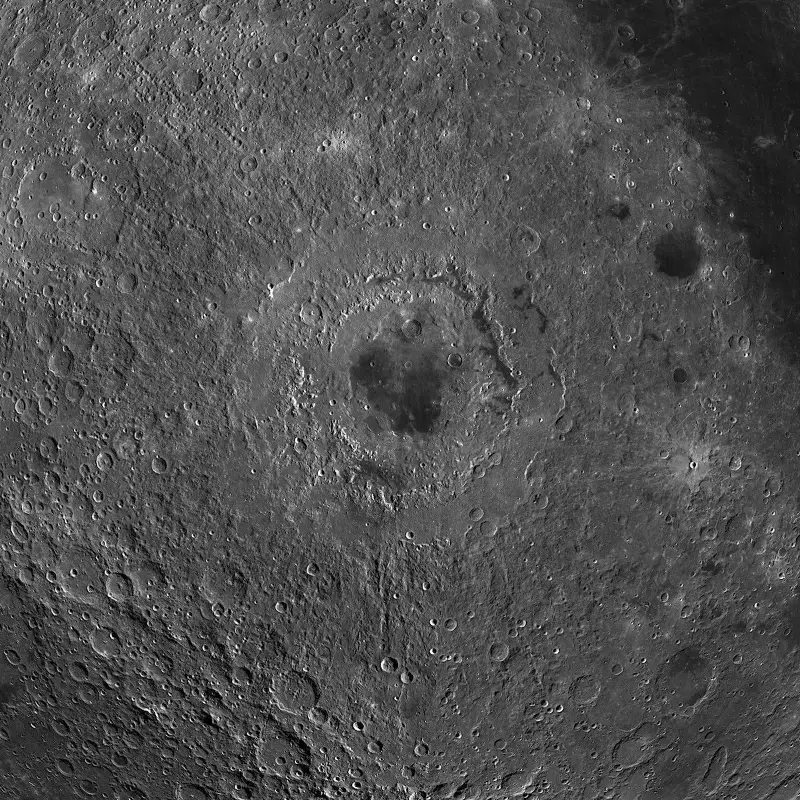
For 3.8 billion years, the breathtaking view of the Orientale basin has lain hidden towards the far side of the moon.
Thought to have been formed after a 40-mile-wide asteroid collided with the Moon, sending molten rock miles into space, the 600-mile crater has until this weekend only been photographed by robot imagers.
But now, the four astronauts on Nasa’s Artemis II mission have become the first humans to see the geological marvel with their own eyes.
The crew of Nasa’s first manned Moon mission in more than five decades are the first people to see in full the three concentric rings of the bullseye-shaped crater, which astronomers can only catch a glimpse of from Earth.
On Sunday, Nasa published a photo showing the Orientale basin on the right edge of the lunar disc and said it was “history in the making”.
“This mission marks the first time the entire basin has been seen with human eyes,” the space agency said.
The crater lies on the border of the near side and far side of the moon and is one of the largest and the best preserved examples of what scientists call multi-ring basins, which are observed on many of the rocky and icy worlds in the solar system.
The shadowed crater resembles a bullseye consisting of three concentric rings.
Scientists have not been able to been able to agree on how multi-ring basins are formed but one study suggests that the rings created when a 40-mile asteroid struck the surface, blasting about 816,000 cubic miles of debris into the sky 62 miles above.
The material would have come crashing back down and sloshed back and forth for two hours, eventually settling into the rings.
No craters as large as Orientale, or with as many rings, have been discovered on Earth and laboratory experiments cannot reproduce multi-ring creations.
Scientists have said that the asteroid collision to create the crater would have been “a world-changing event” and that in a matter of minutes it would have “generated a huge pool of melted rock inside the crater and enormous fault scarps that were several times taller than the Grand Canyon”.
The crater is the youngest of the large lunar basins and the astronauts told how the Moon was appearing larger through Orion’s windows as their journey continued, giving the crew a view of the Moon unlike that seen by humans before.
The crew blasted towards the moon on Friday, marking the first time humans have left the Earth’s orbit since the Apollo 17 mission in 1972.
They will travel 252,000 miles into space, reaching the Moon on Monday, and head about 4,000 miles beyond the Moon to explore its dark side before returning to Earth.
The mission paves the way for a future lunar landing and lays the foundation to send a crew to Mars.
Astronauts Reid Wiseman, Victor Glover, Christina Koch and Jeremy Hansen spent the first 25 hours of the flight circling the Earth, capturing spectacular images of the planet from space.
They are now more than halfway to the Moon and have caught their first views of the lunar surface.
“The darker parts just aren’t quite in the right place,” Ms Koch said in an interview with NBC News. “Something about you senses that is not the Moon that I’m used to seeing.”
Ms Koch added that the crew had compared their views with their study materials to understand what they were seeing. “That is the dark side,” she said. “That is something we have never seen before.”
Mr Wiseman called the flight a “magnificent accomplishment” and said the astronauts’ ability to look at both Earth and the Moon from their spacecraft has been “truly awe-inspiring”.
“The Earth is almost in full eclipse,” he said. “The Moon is almost in full daylight, and the only way you could get that view is to be halfway between the two entities.”