



More than half a century after the glorious era of the Apollo missions, humanity is once again reaching for the Moon.
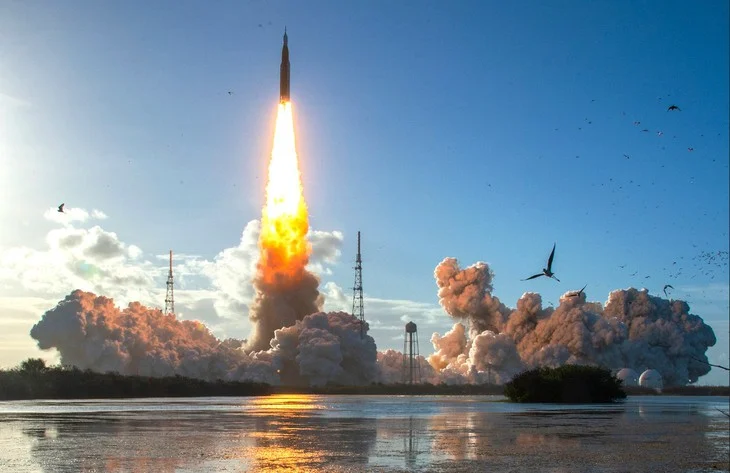
The SLS rocket carrying the Orion spacecraft lifted off from the Kennedy Space Center in Florida (USA) on April 1 (local time) - Photo: AFP
The Artemis II mission is not only a historic milestone for NASA, but also reflects the intense geopolitical competition between major powers in the new space age.
At exactly 6:35 PM on April 1st (Eastern Time), which is the morning of April 2nd in Vietnam, the Space Launch System (SLS) rocket lifted off from launch pad 39B at the Kennedy Space Center (Florida), carrying the Orion spacecraft and four astronauts into orbit.
This marks the first time since the Apollo 17 mission in 1972 that humans have left low Earth orbit to make a journey to the Moon – a moment that astronaut Reid Wiseman said America and the world had been waiting for for a very long time.
A historic moment
More than 400,000 people gathered along the Florida coast, holding their breath as the spacecraft soared into the sky, ablaze with flames. President Donald Trump called it "a miracle" in a speech on April 1 (US time), congratulating the NASA team and the astronauts.
According to Reuters, the Artemis II crew consists of mission commander Reid Wiseman (NASA), pilot Victor Glover (NASA), and two specialists, Christina Koch (NASA) and Jeremy Hansen (Canadian Space Agency - CSA).
Immediately after reaching a speed of approximately 28,000 km/h to enter orbit, the crew began assessing the spacecraft's operational capabilities.
Controllers in Houston confirmed that all four solar panels were successfully deployed, ensuring a continuous power supply throughout the journey.
According to The Guardian , the rocket will orbit the Earth (possibly for up to a day) until the engine is activated to perform the orbital thrust, propelling the spacecraft on its approximately 384,000km journey to the Moon.
This 10-day test flight, while not landing on the Moon, marked several important milestones. Christina Koch and Victor Glover became the first woman and the first person of color to fly into near-lunar space, respectively. Jeremy Hansen from the Canadian Space Agency will be the first non-American to undertake this journey.
Many technologies on board the Orion spacecraft are also being tested in space for the first time, such as the Orion Artemis II optical communication system – which uses lasers to send and receive data from Earth, serving communication needs for future lunar bases.
By the sixth day of the journey, the crew is expected to reach a distance of nearly 407,000km from Earth, surpassing the record of 400,000km set by Apollo 13 in 1970 – bringing humans further from Earth than at any other point in history.
The space race
Artemis II is seen as the foundation for a series of ambitious missions over the next decade. According to Axios, the Artemis III mission, scheduled for 2027, will dock the Orion spacecraft in orbit with lunar landers – including those from Blue Origin (owned by billionaire Jeff Bezos) and SpaceX's Starship (run by billionaire Elon Musk).
Artemis IV is expected to follow in 2028, aiming for a landing at the Moon's South Pole – the location where the Artemis II crew will take the first photographs from an altitude of 6,000-10,000 km during that mission. By 2030, Artemis V could expand the long-term infrastructure – including research bases, settlements, rovers, and cargo landing stations, aiming for a sustainable presence – and even further afield to Mars.
However, that journey did not take place in a "geopolitical vacuum." As scientist Robert Braun from the Johns Hopkins University Applied Physics Laboratory describes, the need for resources and technological development has transformed the Moon into a "ultimate strategic location" for major powers. According to Live Science, while previously the US only competed with the Soviet Union, now its most formidable rival is China.
According to PBS News, Beijing has developed a systematic lunar exploration program with the Chang'e program, focusing on establishing a long-term presence, including plans to build a research station and send humans to the moon by 2030.
Chinese robotic missions have also landed on the far side of the Moon and brought back samples.
Despite the Artemis Accords, initiated by the US – which allow for resource exploitation and the establishment of "safe zones" – and signed by over 60 countries, China has refused to join and has proactively built alliances with Russia and other partners. Some experts even predict that China may be able to put a man on the moon before the US.
The two opposing approaches between Washington and Beijing create a confrontation with two different "rules of the game," reflecting global geopolitical competition rather than purely scientific objectives.
Notably, alongside governments, the private sector is also strongly emerging to drive the formation of a "lunar economy" encompassing resource extraction, space transport, and space tourism.
NASA historian Brian Odom stated: "NASA, the United States, and the world are taking an enormous step forward in their journey towards becoming a space-traveling society."
NASA Administrator Jared Isaacman put it more succinctly: "Success or failure will be measured in months, not years."

Source: NASA
SLS - NASA's most powerful rocket and the cost dilemma.
Despite being NASA's most powerful rocket, the Space Launch System (SLS) has faced considerable criticism: delays, low launch frequency, and enormous costs. The system even experienced hydrogen leaks during pre-launch tests, causing schedule delays.
After more than a decade of development, the budget for the SLS has exceeded $24 billion, with each launch estimated at $2 to $4 billion – significantly higher than its direct competitors, privately-backed missiles.
According to Reuters, a New Glenn flight costs around $18 million, a Starship around $90 million, while reusable rockets like the Falcon 9 have also proven to be significantly more cost-effective.
Faced with that pressure, NASA opened up competitive bidding for missions after Artemis V, allowing multiple companies to participate in launching astronauts and cargo into space.
However, the SLS survived thanks to political support: the Trump administration had proposed halting the SLS after Artemis III, but Senator Ted Cruz pushed for legislation to keep the missile in service until at least Artemis V.
According to expert Casey Dreier of the Planetary Society, "the continued use of SLS is largely a political decision."